Septic Tank Installation in Bali: Types, Costs and What the Rules Say
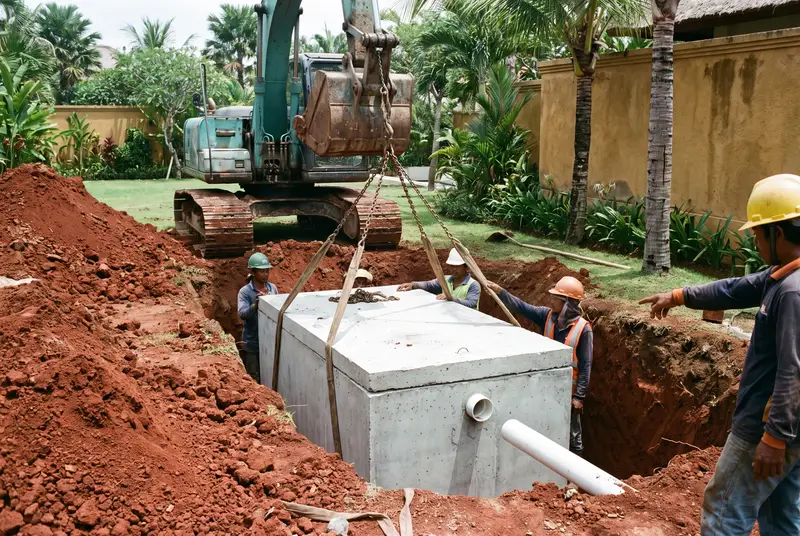
There is no island-wide sewer here. Outside one piped pocket of central Denpasar, every villa and guesthouse treats wastewater on its own land — and most owners never think about the tank until it misbehaves. Here is the ground side of septic system installation: choosing the tank, siting it legally, digging it into Bali’s soils, and the 2026 numbers.
Concrete two-chamber or bio unit — the real choice
Two designs cover nearly every plot. The two-chamber concrete tank is built in the pit — chambers rendered watertight, T-baffles in and out, a vent, a soakaway taking the settled water — affordable, repairable, right for most gardens where soil drains. The sealed bio unit is a factory fiberglass tank with treatment media inside, craned in whole; it earns its premium where groundwater runs high, where the plot squeezes the system toward a well, or where a rental wants cleaner effluent on record.
The tank is sized from how the building sleeps and washes: roughly 1.5–2 m³ of volume per bedroom for a family home — a three-bedroom villa typically carries a 5–6 m³ two-chamber tank — and a size class more for a guesthouse running full beds and daily laundry. Retention time is what a septic tank actually sells; buy enough of it.
Where the tank is allowed to go
Placement is fixed by distances before taste gets a vote. Indonesia’s septic design standard, SNI 2398:2017, and long practice agree: hold every soakaway a full 10 m from any drinking-water well on either side of the fence, let gravity favour the well — tank below it where the land slopes — and stay clear of footings and the boundary so the pit undermines neither. One rule no standard writes down: the pump truck must park within hose reach, or the tank can never be emptied. On a narrow Canggu plot these lines decide the whole layout, so they are drawn before any machine arrives.
The pit: southern clay, Bukit limestone, Ubud loam
A typical residential pit runs 2.5–3 m deep with working room around the tank, and Bali’s geology decides how it goes in. Paddy clay in Canggu, Pererenan and Seseh digs fast, but open walls slump, so the base is trimmed and blinded the same day. On the Bukit — Uluwatu, Ungasan, Pecatu — the pit is breaker work through limestone: slower per metre, though the rock repays you with a soakaway that drains beautifully. Ubud’s volcanic loam digs and drains well; the access track is the real constraint. Along coastal Sanur the water table can run high enough that pumps work in the hole while the base goes in. Soil by area is mapped in Bali soil types; for how machine rates behave island-wide, start with excavation in Bali.
Installation in five steps
- Set-out and a test dig. Well and boundary distances are marked, and one bucket goes down to confirm soil and water level before the price is fixed.
- Pit and connection trench. Machine dig where access allows, hand dig in tight lanes; the lateral from the building’s outlet pipe is trenched at a steady fall — from that pipe outward is earthworks territory.
- Base and tank. A levelled concrete working base, then the chambers go up and get a watertight render — or the bio unit is set and ballasted so it cannot float.
- Soakaway and vent. A gravel field or structured pit sized to the soil’s tested absorption, with the vent riser run where no terrace will ever smell it.
- Test, backfill, record. The tank must hold water before it disappears, and every position lands on a one-page drawing that stays with the house papers.
What the rainy season changes
An empty tank in saturated ground behaves like a boat, so wet-season installs get ballasted and backfilled the same day — or booked for the dry months. And February, not August, shows the groundwater level a soakaway must be designed against. A December dig is workable; it simply needs pumps in the budget — see the rainy season guide first.
What it costs in 2026
Package rates below are current list figures, excavation included:
| Work | Unit | Price (IDR) |
|---|---|---|
| Septic tank standard 2-chamber + soakaway | package | from 9,500,000 |
| Bio septic, supplied & installed | package | from 16,000,000 |
| Machine trench for the connection run, 60 cm deep | m | from 90,000 |
| Hand trench near walls and in tight sites | m | from 140,000 |
Three things move a quote off the list: rock where soil was hoped for, a water table asking for pumps, and access tight enough to force hand digging. The cheap moment is during construction, while machines are already mobilized and no landscaping is at risk. Island-wide digging, trucking and mobilization rates are covered in the excavation cost guide; the full list lives on the pricing page.
Pumping and the years after
A properly sized system asks for little: a desludge every two to four years — sooner for a rental at constant occupancy — and inspection covers kept reachable at grade. Watch for the soakaway warnings: a stripe of suspiciously lush lawn, a wet patch that outlives the rain. And keep stormwater out — roof and yard runoff belongs in its own drainage, because every storm surge through a septic pushes solids into the soakaway and shortens its life.