Bali Soil Types: A Field Guide for Anyone About to Dig
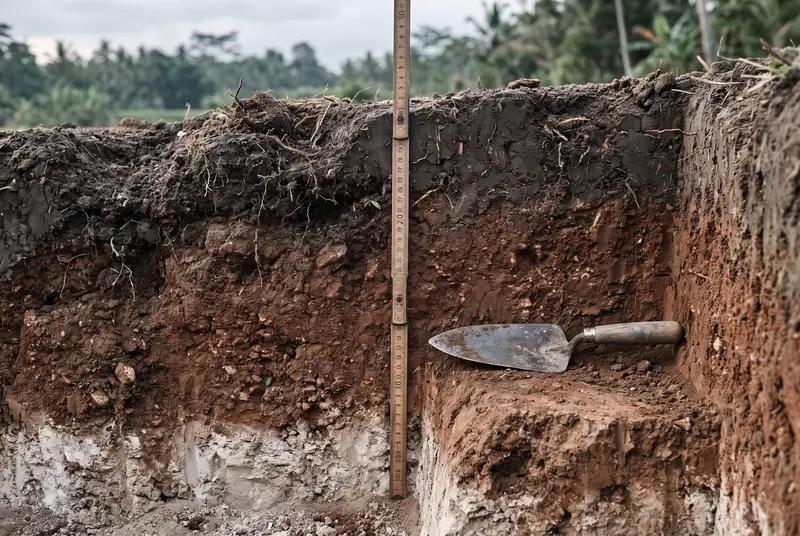
Two plots twenty minutes apart on this island can be quoted IDR 11.5 million and IDR 34 million for exactly the same pool pit, and neither number is a swindle. The difference is whatever the bucket meets at 40 cm down. We dig from the rice fields of Seseh to the plateau above Melasti, and the first thing we do on any site visit is read the ground — because soil sets the method, the machine, the truck count and half your foundation design. Here is that guide, in four soils that cover almost every plot in Bali.
Why soil sets your budget before anything else does
Four numbers in your quote come straight out of the ground. Method: a bucket, a hydraulic breaker or eight men with hoes — and the method picks the machine, which sets the daily cost. Price per cubic meter: machine excavation in normal soil starts at IDR 95,000/m³, hand digging at 300,000/m³, and limestone breaking runs 380,000–550,000/m³ — same trench, four to six times the money. Spoil: everything you dig swells, clay by roughly 25% and broken limestone by 50–60%, so rock also fills more trucks at from IDR 750,000 per 7 m³ load. Foundation: soft ground means deeper footings or piles; sound rock lets you bolt the house to the island. The rest of the price list hangs off those four, and the excavation cost guide works a full plot through line by line.
1. Paddy clay — Canggu, Seseh, Sanur and the rice-field belt
How it looks: dark grey-brown, greasy, and it rolls into a ribbon between your fingers without crumbling. Typically 1.5–3 m of soft alluvium sitting on stiffer clay, often with a black organic plough layer in the top 40 cm that is worth nothing structurally and everything to your garden.
Bearing: weak near the surface, respectable below the soft zone. Digging: the easy part. A machine cuts it from IDR 95,000/m³ and a clean face stands vertical for days in dry weather — then glues itself to the bucket and turns the site into a skating rink after one night of rain. Water: the real story. Across Canggu, Berawa and low-lying Sanur you meet water at 1–2 m, so every foundation and pool pit here runs a sump and a dewatering pump from day one (from IDR 450,000/day). Foundation: batu kali strip footings below the soft layer, or minipiles under anything heavy; slabs on compacted sirtu, never on the paddy.
What goes wrong: footings poured in the top soft layer because it was raining and nobody wanted to dig further; backfill shovelled straight back in with no compaction, which becomes the dip in your driveway two wet seasons later; and digging in December with no pump, which is how a neat trench becomes a swimming pool overnight — more on that in the rainy season guide. Plots around Seseh and Cemagi add one more twist: they are live rice fields being converted, so the subak water still has to flow somewhere, and drainage gets designed before the first bucket, not after.
2. Volcanic loam — Ubud, Tabanan and the uplands
How it looks: brown to reddish-brown, crumbly rather than greasy, no shine when you smear it. This is weathered volcanic ash and tuff, sometimes with a soft white-grey tuff band underneath that cuts like hard cheese.
Bearing: good — the ground operators like best. It cuts clean, does not stick, holds a near-vertical face while you work and compacts beautifully when reused, which is why cut and fill from IDR 95,000/m³ works so well up here: half of what you dig becomes your building pad instead of a truck bill. Water: it drains, but it also seeps. On terraced plots around Ubud and inland Tabanan, water runs along the boundary between weathered and fresh tuff and leaves your cut face weeks after the rain stopped. Foundation: conventional strip footings on the flat; stepped footings plus retaining walls from IDR 1,900,000/m³ on slopes, always with weep holes and a gravel drain behind.
What goes wrong: trusting a dry-season face. A 3 m vertical cut that stood politely through August can let go in one January night, taking the neighbour’s bamboo with it. Batter the slope, or wall it, or both — the full argument with numbers is in building on a slope in Bali, and the volume logic is in cut and fill explained.
3. River boulder conglomerate — Pererenan, Kedungu and the gorges
How it looks: ordinary brown soil with rounded grey andesite stones in it, from fist-sized to fridge-sized. Old riverbeds and lahar flows, and the give-away is the roundness — river boulders are smooth, limestone lumps are not.
Bearing: excellent where the stones interlock, unreliable where they do not — and that inconsistency is the whole problem. A footing half on a boulder and half on soft matrix settles unevenly and cracks the wall above it. Digging: this is the soil that ruins quotes. It gets priced as soil and digs like rock in patches. A mini stops dead against a one-ton boulder; you need a 20-ton machine at IDR 5,400,000/day, or the same machine with a breaker at 7,600,000. We budget these plots at 150,000–380,000/m³ after a test dig, and we will not fix a lump sum on gorge-edge land in Pererenan or Kedungu without opening a pit first. Foundation: over-dig below the boulder line and blind with lean concrete so the footing sits on one uniform surface.
The upside nobody mentions: those boulders are batu kali, and batu kali is what retaining walls and gabions are made of. On a good Pererenan job the stone we dig out of the pad becomes the wall that holds the terrace, and the owner buys nothing. Before you sign a machine hire deal for ground like this, read excavator rental vs hiring a contractor — boulder plots are exactly where day rates get expensive quietly.
4. Bukit coral limestone — Uluwatu, Ungasan, Pecatu, Bingin, upper Jimbaran
How it looks: 20–80 cm of thin red-brown soil, then white or cream coral limestone, often with fossil shells visible in a fresh face. The whole Bukit peninsula is an uplifted reef, and it behaves like one — including karst voids and the occasional cave nobody knew about.
Bearing: superb — almost anything can sit on sound limestone with a shallow pad. Digging: you do not dig it, you break it. Budget IDR 380,000–550,000/m³ and a 20-ton excavator with a hydraulic hammer at 7,600,000/day. A pool pit that starts at IDR 11,500,000 in Canggu soil starts at 21,000,000 in Uluwatu rock and can pass 40 million if it is deep, big, or reached down a lane where only a mini fits — the standing condition on clifftop plots around Bingin. Water: no water table to fight, but limestone drains so freely that a septic soakaway can vanish into a fissure and reappear where you very much do not want it — which is why estate plots in Ungasan and Pecatu get proper soakaway design rather than a hopeful hole.
What goes wrong: buying a flat, cheap, beautiful Bukit plot with a Canggu excavation budget in your head. The structure is cheaper up here and the hole is three times dearer. And on the transition ground — upper Jimbaran hillsides, the Balangan side of Pecatu — soil depth changes across a single plot, so the top of your slope is a soil price and the bottom is a rock price.
Four soils side by side
| Soil | Where you meet it | How we dig it | Price (IDR/m³) | Usual foundation |
|---|---|---|---|---|
| Paddy clay | Canggu, Seseh, Cemagi, Sanur, Kerobokan | Machine + sump and pump, plywood trackway | from 95,000 | Batu kali strip below the soft layer, or minipiles |
| Volcanic loam | Ubud, Payangan, inland Tabanan | Machine, clean cutting, battered faces | from 95,000 | Stepped strip footings plus retaining walls |
| Boulder conglomerate | Pererenan, Kedungu, river gorges | 20-ton machine, breaker on the big ones | 150,000–380,000 | Over-dig and lean-concrete blinding |
| Coral limestone | Uluwatu, Ungasan, Pecatu, Bingin, upper Jimbaran | Hydraulic breaker, saw-cut for clean faces | 380,000–550,000 | Shallow pads straight onto sound rock |
Mixed ground fills the gaps: Denpasar’s older streets hide construction fill and buried foundations, and any reclaimed plot can carry a metre of somebody else’s spoil. Fill is the one material we never trust on sight.
How to read your own plot in an afternoon
You do not need a laboratory for most of this, and if you are still negotiating the land price you should find out before you sign, not after.
- Dig a test pit. 1.2–1.5 m deep, a meter across, in the middle of the plot. Two men with a cangkul, half a day, IDR 300,000–500,000. Photograph the wall of the pit and note where the colour changes, where the hoe suddenly rings, and whether water seeps in while you watch.
- Rub it between your fingers. Rolls into a ribbon and shines — clay. Crumbles and feels floury — volcanic loam. Grits and scratches — sandy or weathered rock. Scrapes white on your thumbnail — limestone.
- Read the neighbours. Tall batu kali retaining walls everywhere means slope and movement. Leaning gate posts, stepped cracks in boundary fences and dipped driveways mean soft ground and bad backfill. Shallow footings exposed in a new cut next door mean rock at that depth.
- Look at what grows. Bamboo, taro and banana say water sits close. Alang-alang grass, frangipani and stunted scrub on thin red soil say rock beneath. Mature coconut palms usually mean at least two meters of workable soil.
- Ask about the well. A neighbour’s well depth is a free water-table survey, and whether it runs dry in September tells you how the ground drains.
- Walk the nearest road cut or riverbank. Somebody has already excavated a cross-section of your neighbourhood for you. Read it.
If you would rather do the pit yourself, our hand digging guide covers tools, safe depths and the point where you must stop.
The soil mistakes that cost owners the most
Accepting a fixed price with no test dig. On limestone or boulder ground, the honest contractor is the one who says he does not know yet; a cheap fixed quote there becomes a variation order in week two. Backfilling with the material you dug out. Paddy clay and boulder soil make terrible structural fill, and sirtu compacted in 20–30 cm layers costs a fraction of relaying a sunken driveway. Ignoring the wet season on soft ground. Digging clay without pumps and a plan is a budget with a hole in it. Assuming one soil across the whole plot. Two pits on anything over 5 are, three on a slope. Skipping the access question. The best soil in Bali still costs double if only a mini fits through the gate — which is why access roads get quoted before the dig, not after a truck sinks.
Not sure what you are standing on? The test dig is free
Send your location pin and a few photos, including any cut face, wall or hole already on the land. We will tell you what we expect to find, and on any project we might work on we open a test pit at our cost — soil or rock, water or dry, before anyone signs anything. Owners have used our results to knock tens of millions off a land price, and that is fine by us; we would rather quote a plot honestly than dig one that should never have been bought.
After the test dig, the same visit gives you an itemised excavation quote for your ground — or a rock breaking quote if the bucket rings on limestone.