What is cut and fill? Site grading explained for villa owners
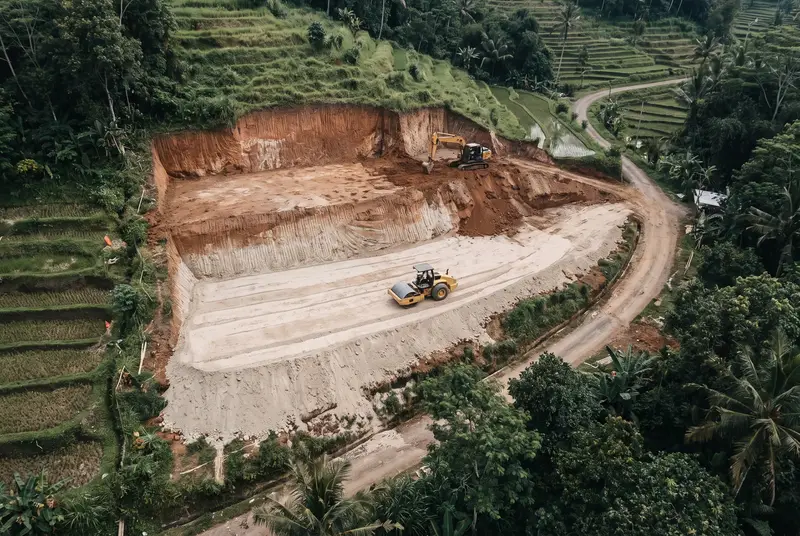
Two owners buy neighbouring plots on the same Tabanan slope. One pays for forty trucks of soil to leave and thirty to come back. The other pays for none, because the soil that left the top of his land simply walked down to the bottom of it. The difference is not luck and it is not a better excavator — it is a grading plan and one afternoon of arithmetic. This is that arithmetic, in plain language and 2026 rupiah.
Cut and fill in one paragraph
Cut is soil removed from the high parts of your land. Fill is soil placed on the low parts to raise them. Cut and fill means doing both with the same material, so it travels twenty metres across your plot instead of twenty kilometres to a dump site and back. On our price list soil moved on site is from IDR 95,000/m³. The alternative is 95,000/m³ to dig, about 750,000 per 7 m³ truck to remove, and 1,100,000 per truck to buy the fill you just threw away. Every cubic meter you balance is roughly 265,000 rupiah you keep.
Why balance is the entire game
Earthworks pricing looks like it is about digging. It is not. Digging is the cheap part — a 20-ton machine moves 300 m³ in a day for 5.4 million. Trucking is the expensive part, and trucks are priced per trip, so cost scales with how far soil travels and how many times you handle it. A balanced site handles soil once. An unbalanced site handles it four times: dig, load, haul, and then the whole sequence again in reverse with purchased fill.
This is why we ask for levels before we quote. On a flat Canggu plot there is nothing to balance and the question is moot. On anything sloped — Pererenan, the ridges above Ubud, the coastal steps at Kedungu — balance is usually the single biggest number in your earthworks budget, and it is decided on paper, weeks before a machine arrives.
What a grading plan and a topo survey actually give you
A topographic survey is a drone flight plus ground control points, delivered as contour lines at 25 or 50 cm intervals. It costs IDR 2.5–6 million for a typical villa plot and it is the cheapest line item in your entire build. On top of it your architect sets finished floor levels, driveway gradients and terrace steps — that is the grading plan. Together they tell us four things nobody can eyeball:
- Volumes. Cubic meters of cut and of fill, computed between existing and design surfaces — not guessed from photos.
- The balance point. Raising finished floor level by 15 cm can turn a 200 m³ deficit into a surplus. Move it before the drawing is frozen, not after.
- Where water goes. Contours are also a rain map. This is where drainage gets designed, or where a February flood gets designed in by accident.
- Machine access. Gradients tell us whether a 20-ton machine can reach the low side or whether we build an access road first.
Kedungu: 1,220 m³ cut, zero trucks
An 18-are plot near Kedungu, falling about 3.2 m from the road down towards the ocean side. The design wanted two building pads and a driveway, which meant 1,100 m³ of compacted fill on the low half. The high half had exactly that soil sitting on it.
What we actually did, priced at our October 2026 rates:
- Cut 1,220 m³ from the road side (extra 10% for compaction shrinkage) and place it in layers on the low side @ 95,000 = IDR 115.9 M
- Compaction, 900 m² in three 25 cm lifts @ 40,000 = IDR 108.0 M
- Final grading of pads and driveway, 1,150 m² @ 30,000 = IDR 34.5 M
- Topo survey and grading plan (third party) = IDR 4.5 M
Total IDR 262.9 million and zero trucks — nothing left the plot, nothing was purchased. Priced the other way, the same volumes look like this: 1,220 m³ dug for export @ 95,000 = 115.9 M, hauled out as 1,525 loose m³ in about 218 trucks @ 750,000 = 163.5 M, and 1,100 m³ of fill bought back as roughly 196 delivered trucks @ 1,100,000 = 215.6 M. That is IDR 495.0 million of earth moving instead of 115.9, plus 414 truck movements down one Tabanan lane in the middle of a village. The 4.5 million survey paid for itself about eighty times over.
The most profitable hour ever spent on a Bali building site is the hour someone spends adding up cut and fill before the machines are booked.
When balance is impossible (and that is fine)
Not every plot can balance, and pretending otherwise is how owners get lied to. On a former rice field in Seseh we had to raise the entire building area 40 cm above the neighbouring subak channel, on land that was already flat. There was no high side to cut from. The plot needed 32 trucks of imported fill at 1,100,000 each, and no amount of clever grading would change that. What we could do was be honest about it in the quote on day one — that budget is broken down in the 2026 excavation cost guide.
The same goes for surplus. A basement in Canggu or a deep pool pit produces soil with nowhere to go on a small plot; it leaves, and we say so. Occasionally we can place clean cut soil with another client nearby, which cuts both disposal and purchase — worth asking about if your project runs alongside a neighbour’s.
Bulking and shrinkage: the numbers nobody mentions
Soil changes volume three times in its life, and quotes that ignore this are wrong before the machine starts:
| State | Volume | Where it matters |
|---|---|---|
| Bank (in the ground, undisturbed) | 100 m³ | What the survey measures |
| Loose (dug, in the truck) | 120–130 m³ | Truck counts — 18 loads, not 14 |
| Compacted (placed in layers) | 88–92 m³ | How much fill you actually need |
Two practical consequences. First, always compute truck counts on loose volume: 300 m³ of Canggu clay is not 43 loads, it is 52–55. Second, always cut about 10% more than your fill requirement. Owners who plan 1:1 discover the shortfall at the end, when the machine has left and imported fill is the only option.
Compaction in layers, or your house cracks
Placing fill is easy. Placing fill that will still be at that level in five years is the actual trade. We build fill in 20–30 cm lifts, each one rolled with a vibro roller (from IDR 3,400,000/day, or 40,000/m² per layer in a measured quote) and each one at sensible moisture — bone-dry clay will not compact, and saturated clay just moves. On anything structural we ask for a density test; on garden and driveway fill, layered rolling with our own inspection is normal.
The rule we repeat on every sloped job: foundations do not sit on fill. If a footing lands in the filled zone, it goes down through the fill to undisturbed ground, or the design changes. Almost every cracked ring beam we have been called to look at — Ubud, Jimbaran, twice in Denpasar — traces back to a column founded on soil that was pushed there by a bulldozer eight months earlier.
What cut and fill costs in Bali in 2026
| Work | Unit | Price (IDR) |
|---|---|---|
| Cut and fill, soil moved on site | m³ | from 95,000 |
| Machine excavation for export | m³ | from 95,000 |
| Compaction in 20–30 cm layers | m² / layer | from 40,000 |
| Final grading of building pad | m² | from 30,000 |
| Imported fill soil, delivered | 7 m³ truck | from 1,100,000 |
| Soil haul-away within 10 km | 7 m³ truck | from 750,000 |
| Vibro roller with operator | day | from 3,400,000 |
| Topo survey + contours (third party) | plot | 2,500,000–6,000,000 |
The complete list is on the pricing page. Terracing on steeper ground usually pairs grading with retaining walls; those numbers, per running meter of wall height, are in building on a slope in Bali. For a price on your own plot, our cut and fill in Bali page carries the service rates, and the volume calculation comes free with the site visit.
Eight questions to ask before anyone starts digging
- How many m³ of cut and how many of fill? Show me the calculation.
- Is the site balanced, in surplus or in deficit — and by how much?
- How many trucks in, how many out, at what distance?
- Are truck counts based on loose volume or bank volume?
- What lift thickness will the fill be placed in, and rolled with what?
- Where will foundations land relative to the filled zone?
- Where does surface water go after the levels change?
- What happens to the schedule if it rains for a week?
A contractor who answers all eight with numbers is worth paying. One who answers “don’t worry, we know this land” is quoting a guess, and you will pay the difference in variations. Ground behaviour differs enormously across the island — worth reading Bali soil types before you sign anything, and the rainy season guide before you pick dates.