Drainage systems in Bali — French drains, channels and soakaways
We design and build drainage for Bali villas and plots: French drains from IDR 450,000/m, concrete U-ditches, catch basins, soakaways and pump pits, all sized for 60–100 mm of rain in an hour. A typical villa perimeter system — 60 m of French drain, two catch basins, one soakaway — lands at IDR 37–57 million. Send a video of where the water goes when it rains on WhatsApp — quote in 24 hours.
FREE SITE VISIT · QUOTE IN 24H · from IDR 450,000/m
Inside the scope
Drainage we build: French drains, U-ditches, soakaways, pump pits
Water survey first
We visit in (or right after) rain when we can — reading where water enters, pools and exits your land. The drawing starts from reality, not from hope.
French drains
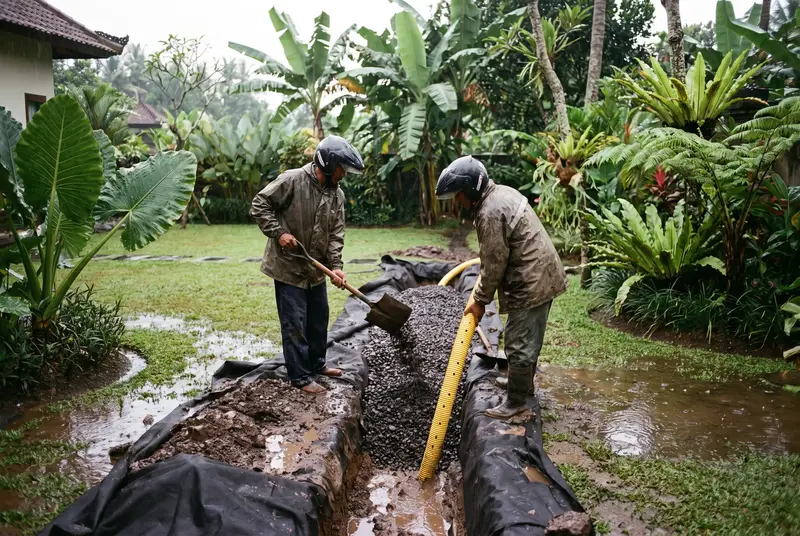
Geotextile-wrapped gravel trenches with perforated pipe, laid to real falls. The workhorse for garden and perimeter water, invisible once the lawn returns.
Surface channels & U-ditch
Concrete U-ditches and grated channels where water arrives fast and dirty — driveways, roof concentrations, uphill neighbours’ runoff.
Soakaway pits
Sized from your roof and paving area, structured and covered — the destination that makes the rest of the system work where there is no street drain to reach.
Pump pits where gravity fails
Low corners in Sanur and Canggu sometimes simply sit below everything. A sealed pump pit with float switch and a checked discharge path solves what slopes can’t.
Tidy reinstatement
Trenches backfilled and compacted, lawn relaid, pavers rebedded. Good drainage should be visible only on the radar and in your dry living room.
Tropical rain math
A serious December cell drops 60–100 mm of rain in an hour. On a 300 m² roof-and-terrace villa that’s up to 30,000 liters arriving in sixty minutes — a water truck every six minutes, parked on your garden. Drainage designed for polite European rain (the default, because that’s what most imported details assume) simply surrenders. Everything we size — pipe diameters, channel widths, soakaway volumes — starts from Bali’s numbers. It’s why our systems look slightly overbuilt in August and exactly right in February.
Reading water before moving soil
The site visit for drainage is a detective job: stain lines on walls, moss maps, where the lawn squelches in dry season (groundwater) versus after rain (surface water), what the uphill neighbour’s new roof does to your boundary. In Canggu the usual villain is a high water table plus paved-over paddy; in the hills near Ubud it’s concentrated runoff arriving from above with real velocity. Different villains, different systems — a French drain for one, a catch-and-channel interception for the other. Diagnosis is free; guessing is expensive.
The French drain, done properly
Everyone sells “French drains”. The version that works for decades: trench to a surveyed fall (min 1%), geotextile wrapping the gravel so Bali’s fine silt can’t clog it in two seasons, perforated pipe at the bottom (holes down — yes, down), washed gravel, and a destination that can actually receive the water. The version that fails: a gravel trench with no fabric, no fall and no destination — a buried bathtub. The price difference is maybe 20%; the lifespan difference is tenfold.
Soakaways, and when they’re the wrong answer
Where ground can drink — most of the island’s volcanic soils — a structured soakaway is the elegant end point: your roof water recharges the same aquifer your well drinks from. But in Sanur and low coastal Canggu, wet season groundwater rises to where the soakaway floor is already underwater, and pouring rain into saturated ground is theatre. There the honest design is storage plus a pump pit with a verified discharge route. We’ll tell you which physics your plot obeys before quoting either.
Landscape drainage design for villa gardens
Garden drainage is designed like a small catchment, not added pipe by pipe. We start from the levels: lawns and planting beds fall 1–2% away from the house, terraces and paths shed water sideways into channels, and no surface drains toward a door. Where water collects, catch pits with grated tops take it underground; French drains along the uphill boundary and at the foot of every terrace or retaining wall intercept seepage before it reaches the backfill. Every pipe run keeps at least a 1% fall to one destination — a soakaway sized to the roof and paved area, or a pump pit where the garden sits too low.
Two neighbours in the garden get their own rules. The septic system stays separate: roof and yard water never enters the tank or its soakaway, and storm drains keep clear of the soakaway field. The pool gets a deck channel so rain does not wash garden soil into the water, and its backwash and overflow get a planned discharge instead of the lawn — something we set out together with the pool excavation. Designed before landscaping, this costs a drawing and a day of levels; retrofitted, it costs the lawn.
Costs, and the cheap moment to act
A full villa perimeter system — 60 m of French drain, two catch basins, one soakaway — typically lands between IDR 37 and 57 million. The same scope after a flood has already been through the living room costs the same, plus the floor. The cheap moment is dry season: machines move freely, lawns recover fast, and you beat the November queue. Full rates on the pricing page; scheduling logic in the rainy season guide →
Pricing
Drainage prices per metre and per unit (2026)
| Work | Unit | Price (IDR) |
|---|---|---|
| French drain (gravel, geotextile, pipe) | per m | from 450,000 |
| Concrete U-ditch 30 cm, installed | per m | from 800,000 |
| Soakaway pit, built & covered | per unit | from 5,500,000 |
| Catch basin / grated inlet | per unit | from 1,200,000 |
| Pump pit with pump, installed | per unit | from 6,500,000 |
| Surface regrading for flow | per m² | from 30,000 |
October 2026 rates. A video of your worst flooding moment is the most useful thing you can send — quotes get accurate fast. Full price list on the pricing page.
Read the table as honest orientation rather than a public offer; the binding figure is set in the written quote that follows the free plot walk.
Price your drainage: send a video of the problem area in rain (or the stain lines after it), the plot pin and a rough garden sketch — we reply with the system we would build and a per-metre price within 24 hours.
Price My DrainageRelated
Crews often pair these
FAQ
Drainage systems in Bali — FAQ
Our villa floods every December. Is that actually fixable?
Almost always, and usually less dramatically than owners fear. The typical fix is a perimeter French drain intercepting water before the terrace, plus a properly sized soakaway. The site visit (free) tells us which of the three usual suspects you have: incoming surface water, rising groundwater, or roof water with nowhere to go.
Is there a storm sewer to connect to in Bali?
Outside a few urban streets in Denpasar and Kuta — no. Your rain must soak into your own land (soakaway), cross legally into a village channel where one exists, or be pumped. This is why soakaway sizing matters here in a way it doesn’t back home, and why “just pipe it away” quotes should worry you: away to where?
How big does a soakaway need to be?
Rule of thumb we size from: about 1 m³ of soakaway per 25 m² of roof/paving in average soil — more in clay, less in sand. A typical villa needs 4–8 m³. In high-water-table areas like Sanur soakaways work poorly in the wet season, and the honest design shifts to storage-plus-pump.
Will drainage protect my retaining wall too?
It’s half of what keeps walls standing. Surface water managed before it reaches the backfill means the wall’s own backdrain handles only what soaks naturally. If you’re building a retaining wall, price the drainage with it — same trench crew, same mobilization, meaningfully cheaper together.
What maintenance does a drainage system need?
Honest answer: some. Leaf traps cleaned monthly in leaf-drop season, channels swept, the soakaway inspection cover lifted once a year, pump float tested before November. We hand over a one-page maintenance sheet and offer a pre-wet-season check visit — cheap insurance before the radar turns purple.
Get a free site visit and a volume-based quote
Send us your location pin and a few photos of the land on WhatsApp. We visit the site, measure levels, calculate real volumes and send a line-by-line volume quote — normally back with you inside 24 hours, and you owe nothing for it.
FREE SITE VISIT · QUOTE IN 24H · OWN MACHINES