Earthworks in Bali’s Rainy Season: What Works, What Waits
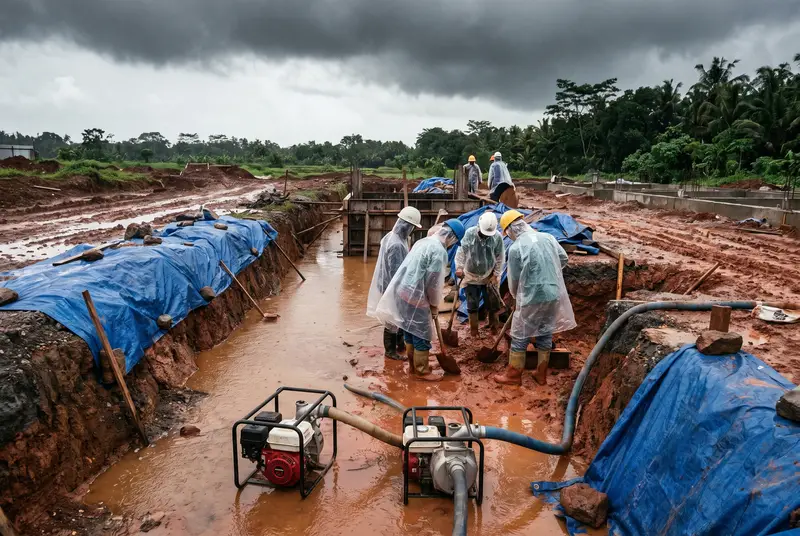
Two things happen every November. Owners who booked in the dry season panic and ask if work should stop, and owners who waited all year phone to start immediately. Both are usually wrong. The wet season doesn’t close Bali’s earthworks — it reorders them. Here is exactly what we dig from November to March, what we refuse to touch, and what water control does to your budget.
The wet-season calendar, month by month
South Bali gets roughly 300–350 mm of rain in January against 40–60 mm in August. But the monthly total is the wrong number to plan with. What decides your week is intensity: a single convective cell over Canggu or Ubud can drop 60–100 mm in an hour, usually between 14:00 and 18:00, then clear. An hour of that fills an open pit and turns a clay haul route into a skating rink; the other twenty-three hours are workable.
| Month | Typical pattern | Earthworks verdict |
|---|---|---|
| November | First real storms, ground still dry underneath | Best window — start now |
| December | Heavy, frequent afternoon cells; ground saturating | Selective |
| January | Peak; multi-day systems, water table at its highest | Drainage, rock, walls |
| February | Still peak, short clear windows, high humidity | Selective |
| March | Tapering; land dries week by week | Grading returns |
| April–May | Transition, firm ground, no queue yet | Everything, best value |
What we do, watch, and postpone
| Work | November–March | Why |
|---|---|---|
| Drainage, French drains, soakaways | Best season | You can see where water actually goes |
| Rock breaking on the Bukit | Yes | Limestone drains; the breaker doesn’t care |
| Retaining walls with proper drainage | Yes | Weep holes and backfill get tested immediately |
| Trenching in free-draining ground | Yes | Short runs, backfilled the same day |
| Land clearing and grubbing | Yes | Roots pull easier; keep trucks off the soft ground |
| Foundation excavation with pumps | Careful | Needs sump, pumps and concrete right behind the dig |
| Pool excavation | Careful | Wall collapse and empty-shell flotation risk |
| Cut and fill plus compaction in clay | No | Wet clay will not reach density, ever |
| Engineered fill and embankments | No | Layers trap water and settle for years |
| Access roads without geotextile | No | Sirtu disappears into the mud in one week |
| Large open basements without a dewatering plan | No | Nothing good happens in a flooded excavation |
Why clay is the villain and limestone is the friend
Everything above comes down to what is under your feet. Paddy clay in Canggu, Seseh and Pererenan holds water like a sponge. Compaction only works near a soil’s optimum moisture content; in February that clay sits 8–10% above it, and a vibro roller just makes the ground bounce — the operators call it rubber soil, and no number of passes fixes it. Fill placed on top of that is settlement you will meet in three years as cracks in a terrace.
Bukit limestone behaves in the opposite way. In Uluwatu, Ungasan and Pecatu the rain vanishes into the rock within minutes, so breaker work runs almost normally from December to February — we book those jobs deliberately in the wet months. Volcanic loam around Ubud sits between the two: it digs fine and it drains, but the jungle access tracks are what stop you. Sanur and low-lying Denpasar have their own problem — high groundwater that rises to within half a meter of the surface. The full field guide is in Bali soil types.
The techniques that make wet-season work possible
- Sump first, always. The lowest corner of the excavation is dug and deepened before anything else, and two pumps live in it at IDR 450,000 a day each. Water goes to a settlement pit or a legal outfall, never over the neighbour’s boundary.
- Tarps and a crest berm. Cheap blue sheeting over the cut faces and a small bund along the top edge stop 80% of what would otherwise run into the pit. Cost: a few hundred thousand rupiah. Value: your bearing surface.
- A gravel working platform. Geotextile plus 20–30 cm of sirtu where the machine stands and the trucks turn. Without it, day three is spent towing a dump truck out of your own site.
- Radar windows. We start at 07:00 in the wet months, not 08:00, and plan the water-sensitive tasks before lunch. Afternoon is for loading, tidying and covering up.
- Compressed sequence. Dig, hand-trim, inspect, blind with lean concrete — all in one day, on the same section. An open footing bottom left overnight in December is a soft footing bottom in the morning.
- Short open lengths. Trenches go in 20–30 m sections and get backfilled the same shift instead of running 120 m of open utility trench across a site.
- Cover your stockpile. Cut soil you intend to reuse as fill has to stay coverable and drained, or it stops being fill and starts being a disposal cost.
What it does to your schedule and budget
Our rates per m³ do not change with the season. What changes is the number of days and the water-control line. Here is the same 140 m³ villa footprint in Canggu, quoted twice:
| Line item | Dry season | December–February |
|---|---|---|
| Excavation 140 m³ @ 95,000 | 13,300,000 | 13,300,000 |
| Haul-away (25 loads dry / 28 wet) | 18,750,000 | 21,000,000 |
| Dewatering pumps | 1 × 4 days 1,800,000 | 2 × 8 days 7,200,000 |
| Sump, tarps, crest berm | — | 1,200,000 |
| Standing rain days @ 1,700,000 | — | 2 days 3,400,000 |
| Total | 33,850,000 | 46,100,000 |
| Calendar time on site | 4 days | 8–9 days |
Strip out the extra trucks — wet soil is heavier and spills, so loads carry less — and the honest wet-season premium on a typical dig is 10–20% plus roughly double the calendar time. That is the real trade. Nobody should be surprised by it in month two, which is why our wet-season quotes state the pump count, the rain allowance and the standing rate up front. Everything on this page maps to the numbers on the 2026 price list.
Why the dry season isn’t automatically cheaper
From June to September every villa in Bali is building. Machines get booked three to five weeks out, mobilization slots go to whoever commits first, and concrete trucks queue. Owners in Kedungu and Jimbaran routinely lose a month of project time to a machine that simply wasn’t available — and a month of villa rental or delayed income is worth far more than the 10–20% you saved on water control. In January we can usually be on site next week, with our best operators, because the tourists of the earthworks trade have gone home.
There is a quality argument too. A retaining wall built in the wet gets its drainage tested by 100 mm of rain the week it is finished, while we are still on site to fix anything. The same wall built in August gets tested in December, when we are somewhere near Bingin and you are watching water come through the terrace. See building on a slope for how we detail those.
How to plan three months ahead
- Working backwards from your pour date. Want footings poured in January? Book the dig for early November. Want bulk cut and fill compacted properly? That lands in April–May or June, never January.
- Drainage first, and in the wet. Design it while the water is showing you the answer, then build it. It is the one job the rainy season makes better, not worse.
- Build the access road before you need it. Geotextile and sirtu in October costs the same as in January, but in January it also costs you three lost delivery days. See access roads.
- Do your test pits in February. The groundwater level you see at peak wet is the design case for your foundations and septic. The one you measure in August is a comfortable lie.
- Book earthworks and walls in one mobilization. Combining the dig with retaining walls and drainage saves a full mobilization charge and, in the wet, an entire remobilization risk.
- Keep a machine decision open. If your scope is loose, compare a contract against day-rate hire — the standing-day rules matter far more in the wet, as our excavator rental guide explains.