Retaining wall construction in Bali — stone, concrete and gabion
We build batu kali, gabion and reinforced concrete retaining walls with footings cut below the slip line, a gravel-and-geotextile backdrain, weep holes every 1.5 m and backfill compacted in layers. From about IDR 760,000 per running metre for a 1 m batu kali wall; walls above 2 m are built to an engineer’s drawing. Send photos of the slope and its rough height on WhatsApp — free site visit and a written quote in 24 hours.
FREE SITE VISIT · QUOTE IN 24H · from IDR 760,000 per metre
Inside the scope
Every wall we build: footing, backdrain, weep holes, compaction
Wall selection & engineer liaison
Batu kali, gabion or reinforced concrete — chosen for your height, soil and budget. Above ~2 m we work from an engineer’s drawing and can bring the engineer.
Footing excavation & base
Walls fail from below: footings cut into firm ground below the slip line, compacted base, correct embedment. The invisible half of the price, never skipped.
The wall itself
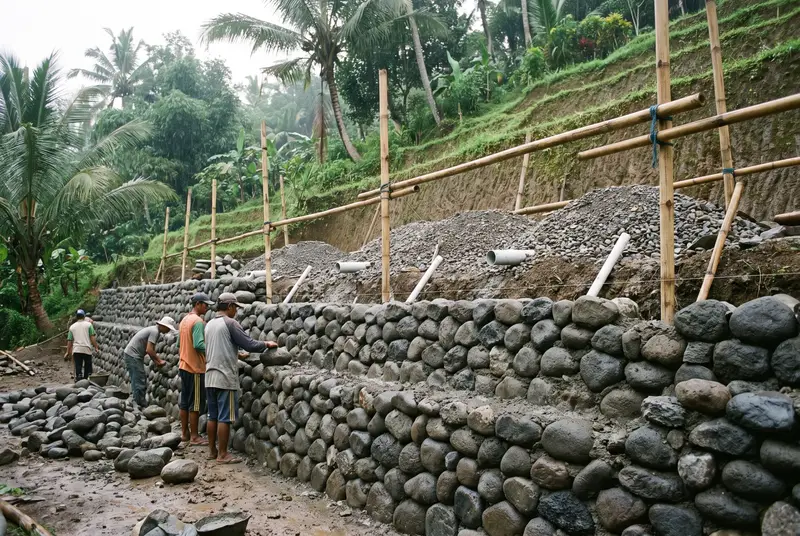
River stone laid by masons who’ve done it for decades, gabion baskets packed tight and wired properly, or shuttered concrete with real cover on the steel.
Weep holes & backdrain
Every wall gets weep holes and a gravel-and-geotextile backdrain with perforated pipe. Water pressure is what pushes Bali walls over — we let it out.
Compacted backfill
Backfill placed in layers and compacted, graded to fall away from the wall. Loose-tipped backfill settles, cracks paving and loads the wall — so we don’t do it.
Finish options
Exposed stone face, plaster-ready block skin, planted terrace pockets or climbing-green gabion — the structural wall can still be the pretty one.
Walls fail from water, not from weight
The physics is unglamorous: soil behind a wall doubles in effective load when saturated, and water trapped against the back face adds hydrostatic pressure on top. A Bali wet season delivers both, weekly. That’s why every wall we build is a drainage system wearing stone — gravel and geotextile at the back, perforated pipe at the footing, weep holes through the face at 1.5 m spacing. Owners pay for the visible stone; what they’re actually buying is the invisible gravel.
Batu kali, gabion or concrete — the honest comparison
Batu kali (river stone masonry) from IDR 1.9 million/m³: the classic Bali wall — economical, handsome, right for terraces up to ~2 m. Gabion from 1.35 million/m³: fastest to build, drains through its whole face, tolerates ground movement, and on the Bukit can be packed with your own broken limestone from rock excavation — the budget option that engineers respect. Reinforced concrete from 2.95 million/m³: for serious heights, thin footprints and anything carrying a building. We quote the one your slope needs; when two would work, you get both numbers.
Where Bali needs walls most
Pererenan’s river-gorge plots almost always pair a villa with a wall — the buildable flat is bought with a retained edge. The hillsides above Jimbaran bay cut into mixed soil-over-limestone that begs for stepped terraces. And around Ubud, jungle slopes are traditionally terraced — we’ve rebuilt fifty-year-old subak-style walls there with modern drainage hiding behind original-looking stone. Each area page carries local notes; each slope still gets its own site visit.
The wall is half the project — grade the rest
A retaining wall rarely travels alone. The slope above wants grading to terraces, the terrace wants surface drainage so water never reaches the backfill in volume, and the footing dig produces spoil that usually becomes the fill for the next terrace down. Quoted together in one mobilization, the combined price routinely comes in 15–25% under the sum of separate contractors — one machine set, one crew, one schedule.
What a wall really costs
Price walls per m³ of built wall, not per m² of face — thickness matters and thin walls are how failures start. Worked example: 38 m of batu kali at 3.2 m average height in Pererenan — footings, 118 m³ of stone, full backdrain, compacted backfill — comes to about IDR 236 million at our October 2026 rates, three weeks on site. The slope guide carries per-meter-of-height budgets for planning; the free site visit turns yours into a fixed written number.
Price per metre
Retaining wall price per metre (batu kali, concrete, gabion)
Built-wall prices per running metre of wall, by retained height, derived from our unit rates: batu kali from IDR 1,900,000/m³, gabion from 1,350,000/m³, reinforced concrete from 2,950,000/m³. Cost grows with height squared — three 1.2 m terraces are far cheaper than one 3.6 m wall.
| Retained height | Batu kali (IDR/m) | Gabion (IDR/m) | Reinforced concrete (IDR/m) |
|---|---|---|---|
| 1.0 m | ~760,000 | ~1,350,000 | not economical |
| 1.5 m | ~1,520,000 | ~2,030,000 | ~2,190,000 |
| 2.0 m | ~2,480,000 | ~3,380,000 | ~2,990,000 |
| 2.5 m | ~3,620,000 | ~4,730,000 | ~4,070,000 |
| 3.0 m | ~5,140,000 | ~6,080,000 | ~5,310,000 |
| 4.0 m | engineer’s design | rarely suitable | ~8,440,000 |
Add 15–25% for excavation behind the wall, gravel backfill, weep holes and the drain that keeps it standing. Orientation for 2026; the exact number is fixed after the free site visit. Worked slope budgets are in our building on a slope guide.
Price your wall: send photos of the slope, the length in metres and the height you need to hold — we reply with the right wall type and a price per metre within 24 hours.
Price My Wall per MetrePricing
Unit rates per m³ of built wall (2026)
| Work | Unit | Price (IDR) |
|---|---|---|
| Batu kali stone retaining wall, built | per m³ | from 1,900,000 |
| Gabion wall incl. stone & mesh | per m³ | from 1,350,000 |
| Reinforced concrete cantilever wall | per m³ | from 2,950,000 |
| Footing excavation | per m³ | from 95,000 |
| Backdrain (gravel, geotextile, pipe) | per m | from 450,000 |
| Engineer’s design & drawings | per wall | from 4,000,000 |
October 2026 rates, materials included. Height and ground conditions set the real number — walls are quoted only after we stand on your slope. Full price list on the pricing page.
Read the table as honest orientation rather than a public offer; the binding figure is set in the written quote that follows the free plot walk.
Related
Crews often pair these
FAQ
Retaining walls in Bali — FAQ
How much does a retaining wall cost in Bali?
Per cubic metre of built wall: gabion from IDR 1,350,000, batu kali stone from IDR 1,900,000, reinforced concrete from IDR 2,950,000 — materials included, plus footing excavation from IDR 95,000/m³ and a gravel backdrain from IDR 450,000/m. A wall’s real price is set by its height and the ground behind it, so we quote only after standing on your slope; the free site visit and written quote take 24 hours.
Which wall type is right for my slope?
Rough guide from seven years of Bali slopes: under 1.5 m retained — batu kali stone is economical and looks right. 1.5–3 m — gabion or engineered stone/concrete, designed properly. Over 3 m — engineer-designed concrete or terraced multiple walls, no exceptions. We quote the honest option, including when that’s “two smaller terraces, not one heroic wall”.
Why do so many retaining walls in Bali fail?
Water, almost every time. A wall that stood all dry season hits February saturated soil that weighs half again as much, with hydrostatic pressure behind it and no weep holes to relieve it. Add footings dug into topsoil and un-compacted backfill and the collapse writes itself. Our walls drain — that’s the whole secret.
Do I need an engineer for my retaining wall?
Above 2 m of retained height, or any height holding ground under a building — yes, and we won’t build it otherwise. We work with licensed engineers whose drawings we trust and whose site checks are quick. Below that, standard details we’ve built hundreds of times are sufficient — and we’ll show you them in the quote.
How long does a wall take to build?
Rule of thumb: a 20 m batu kali wall at 2 m height takes 2–3 weeks including footings, drainage and backfill. Gabion goes faster (the baskets are the formwork), concrete slower (curing). The quote carries a week-by-week schedule so your landscaper knows when the terrace is theirs.
Our existing wall is leaning — can it be saved?
Sometimes. A lean caught early can be relieved: excavate the backfill, add drainage, rebuild the top third. A wall bulging at the base with cracked stones is finished — propping it is throwing money at physics. We inspect free, tell you which one you have, and quote rebuild vs relieve honestly. See also building on a slope →
Harga retaining wall batu kali per meter?
Harga talud batu kali per meter lari tergantung tinggi dinding: sekitar Rp 760.000/m untuk tinggi 1 m, Rp 1.520.000/m untuk 1,5 m, Rp 2.480.000/m untuk 2 m dan Rp 5.140.000/m untuk 3 m. Tambahkan 15–25% untuk galian, urugan kerikil, lubang rembesan (weep hole) dan drainase di belakang dinding. Harga pasti kami tetapkan setelah survei lokasi gratis — kirim foto lereng lewat WhatsApp.
Berapa lama pasang talud?
Talud batu kali sepanjang 20 m dengan tinggi 2 m biasanya selesai dalam 2–3 minggu, termasuk pondasi, drainase dan urugan yang dipadatkan per lapis. Bronjong (gabion) lebih cepat, dinding beton bertulang lebih lama karena waktu curing. Jadwal per minggu kami cantumkan di penawaran tertulis.
Get a free site visit and a volume-based quote
Send us your location pin and a few photos of the land on WhatsApp. We visit the site, measure levels, calculate real volumes and send a line-by-line volume quote — normally back with you inside 24 hours, and you owe nothing for it.
FREE SITE VISIT · QUOTE IN 24H · OWN MACHINES