Digging a Foundation by Hand in Bali: An Honest DIY Guide
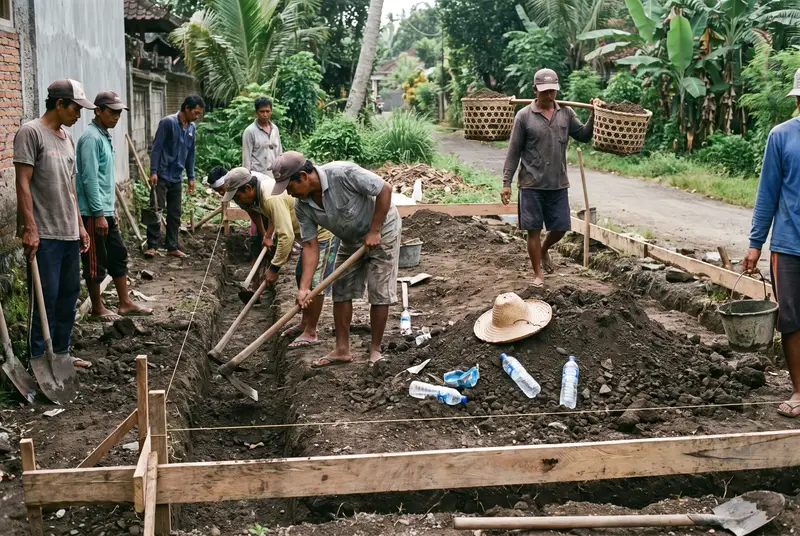
Bali is one of the last places on earth where a foundation dug by hand is a normal, sensible and occasionally cheaper choice — and where the people who do it are genuinely skilled at it. So this is not the article where a contractor who owns excavators talks you out of a shovel. We run machines and we run hand crews, and we send the hand crew whenever the hand crew is the right answer. Here is the honest version: when digging by hand wins, what it actually costs, how to do it properly, and the depth past which people get killed doing it.
When hand digging genuinely makes sense
Small volumes. Under roughly 15–20 m³ a machine spends most of its money arriving. Mobilization for a mini excavator in south Bali is IDR 1,500,000–2,500,000 on the flatbed both ways, before one bucket of soil moves. A septic pit, a drainage run or the footings for a single bale do not justify that. Access. Half the plots in Canggu hide behind gangs where 1.8 m of clearance is an optimistic estimate, and clifftop land near Bingin is reached by a path, not a road. Retrofitting a drain behind a finished villa in Sanur means the machine would have to drive through the living room. Precision. The last 10–15 cm of a footing base, square corners, a 40 cm trench beside a neighbour’s wall — a bucket cannot do these without over-digging, and over-dig is paid for twice, once in soil and once in concrete. Unknown services. When you do not know where the PDAM line or the PLN cable runs, hand digging is not the cheap option, it is the only safe one — which is why our own utility trenching price list carries a separate hand rate for work near existing pipes.
The math: four men against a mini excavator
Everyone quotes the day rates at each other and nobody divides by output. Here is the division, using 2026 numbers we actually pay:
| Item | Hand crew (4 men + mandor) | Mini excavator PC50–75 |
|---|---|---|
| Day cost | 1,100,000–1,400,000 | from 3,400,000 |
| Mobilization | none — they arrive on scooters | 1,500,000–2,500,000 |
| Output in soft paddy clay | 4–6 m³/day | 40–60 m³/day |
| Output in dense or boulder ground | 1.5–3 m³/day | 25–40 m³/day |
| Effective cost per m³ | ~220,000–300,000 | ~60,000–95,000 |
Run two real jobs through it. A septic pit, 2 × 2 × 2 m = 8 m³: hand crew, two days, about IDR 2.6 million. Machine, one day at 3.4 million plus 2 million mobilization = 5.4 million. Hand wins, comfortably. A villa footing package, 60 m³: hand crew, twelve working days, about IDR 15.6 million and three weeks of your life. Machine, a day and a half plus mobilization, roughly 7 million, finished before the weekend. The machine wins twice over.
The crossover sits at 15–20 m³ in soft ground and drops to about 8–10 m³ the moment the ground gets hard, because hand output collapses much faster than machine output does. For reference, our supervised hand digging rate is from IDR 300,000/m³ and machine excavation is from 95,000/m³ — the gap between our hand rate and the raw crew cost is setting out, levels, spoil handling and someone responsible for the sides not falling in. Full numbers are on the pricing page, worked budgets in the excavation cost guide, and the rent-versus-hire argument in excavator rental in Bali.
Who actually digs: hiring a crew the local way
You will be offered two structures. Harian (daily) is IDR 150,000–250,000 per labourer and 300,000–400,000 for a mandor, with meals, coffee and water expected on top at roughly 25,000–35,000 per head. Borongan is a lump sum for a defined result — this hole, these dimensions, this deep, spoil stacked there. Our advice after years of both: take borongan whenever the shape of the job is known, because harian quietly rewards a slow week; keep harian only for genuinely unpredictable work like chasing an unknown pipe.
Pay for the mandor even on a small job. He sets the lines, reads the level, decides when a wall needs battering back, and he is the reason four men dig a trench instead of four separate holes. Standard hours are 07:00 to 16:00 with a long midday break — sensible in this climate, and the reason output is measured per day rather than per hour. Check that whoever you hire has BPJS cover, or arrange it; an injury on your land without it becomes your problem in every sense.
What you need: tools with 2026 Bali prices
Everything below is on the shelf at any toko bangunan in Denpasar, Kerobokan or Ubud. Street prices, mid-2026:
| Item | What it does | Price (IDR) |
|---|---|---|
| Cangkul (hoe) | The main digging tool here, not the shovel | ~85,000 |
| Sekop (pointed shovel) | Lifting and loading spoil | ~120,000 |
| Linggis (crowbar, 1.5 m) | Roots, stones, compacted layers | ~180,000 |
| Ember (buckets), 5 pcs | Lifting spoil out of deep trenches | ~100,000 |
| Keranjang (carrying basket) | Moving spoil where a barrow cannot go | ~45,000 each |
| Gerobak (wheelbarrow) | Anything over a 10 m throw | ~550,000 |
| Tali nylon line + patok pegs | Setting out and holding it | ~60,000 |
| Selang waterpas (10 m water level) | Transferring one datum around the site | ~55,000 |
| Spirit level, 60 cm | Trench base and formwork | ~90,000 |
| Meteran, 30 m tape | Setting out, checking diagonals | ~120,000 |
| Plywood sheet 12 mm + props | Shoring a wall you cannot batter | ~145,000/sheet |
| Dewatering pump, rented | Non-negotiable in the wet season | from 450,000/day |
| Boots, gloves, hard hat per person | The cheapest line on this list | ~250,000 |
A workable kit lands at IDR 1.5–2 million, most of it reusable. Note what is missing: no laser, no compactor, no shoring frames. Rent a vibro plate for backfill, and if the job needs real shoring you have already crossed into the territory of the last section.
Step by step: setting out and digging a footing trench
1. Find the services before you find them the hard way. Ask the neighbours where the water and power come in, look for meter boxes, valve covers and suspicious lines of newer paving, then scrape the first 30 cm by hand along the whole route before anyone swings a cangkul.
2. Build bouwplank (batter boards). Timber frames set about a meter outside each corner, with nylon lines strung between them. This is the step DIY diggers skip and then regret, because pegs in the trench line disappear the moment digging starts, while boards outside it survive the whole job and let you re-check the setting out any time. Prove the rectangle by measuring both diagonals — they must match.
3. Fix one datum and measure everything from it. Mark a reference point on an existing wall or a driven peg, then walk it around the site with a water-level hose. Every depth is measured down from that single mark, never from the ground surface — Bali plots are never as flat as they look, and this is where most amateur trenches end up stepped.
4. Dig in layers, not plunges. Take 40–50 cm across the whole length, then the next 40–50 cm. It keeps the base level, keeps the sides even, and lets you see the soil change before you are standing in it. Keep spoil at least a meter back from the edge — a heap on the lip is a surcharge load, and surcharge loads are what push a wall in.
5. Batter the sides once you pass a meter. In firm clay a 1:0.5 slope is normal, in loose or filled ground 1:1. If a wall or a boundary means you cannot cut the slope back, you shore with plywood and props — or you stop and call someone.
6. Trim the base by hand and keep it dry. Clean the last 10 cm to the line so the concrete sits on undisturbed ground, dig a small sump in the lowest corner and pump it out. Never leave an open trench base overnight in the wet season: it softens, and you will be digging it again in the morning. Sequence the pour to follow the dig closely — the reasoning is in earthworks in the rainy season.
7. Backfill in 20–30 cm layers, compacted. Not one push of the heap back into the hole. Water the layer lightly, run a vibro plate over it, then the next. This is the difference between a driveway that stays flat and one that grows a dip by the second wet season.
The mistakes that cost money — and the one that kills
Vertical walls deeper than 1.2 m. This is the fatal one. A cubic meter of wet clay weighs close to 1.8 tonnes, gives no warning, and does not need to bury you to kill you — waist-deep is enough to crush a ribcage. Batter it, shore it, or do not enter it. Working alone at depth. Nobody at the surface means nobody to pull you out or call anyone. Digging clay in December without a pump. A trench full of water is not a delay, it is a softened bearing base you were about to build on. Measuring from ground level. Sloping ground plus per-corner measurements equals a stepped footing and an argument with your builder. Backfilling with uncompacted spoil. Cheap today, a sunken terrace in eighteen months. Undermining a neighbour. Digging deeper than the bottom of an adjacent wall footing, within about two meters of it, is how boundary walls crack — and how a friendly banjar conversation turns into a formal one.
When you must not do this without machines
Some jobs punish learning by doing, so here is the line drawn plainly. Anything past 1.5 m deep, or any depth where the sides cannot be battered back properly. Bukit limestone — coral rock in Uluwatu, Ungasan, Pecatu and Jimbaran does not yield to crowbars; it needs hydraulic breaking, and hand attempts end up costing more per m³ than the machine would have. Boulder ground around Pererenan and the river gorges, where a single stone can stop a crew for a day. High water table sites in Canggu, Seseh and low Sanur, where dewatering has to be designed rather than improvised. Volumes over about 30 m³, where hand cost passes machine cost and keeps going. Pool pits — a pool excavation needs correct overdig, stable walls and tolerances a hand crew cannot hold. Slope cuts, where the excavation and the retaining wall are one engineering problem, explained in building on a slope in Bali. And septic soakaways in rock, where the pit has to be sized and sealed correctly rather than simply dug — see septic systems.
Want to try it yourself? We will help you work it out
This sounds strange from a company that owns excavators, but we would rather you dug a small job well than badly. Owners who understand what happens below ground make far better clients on the jobs that genuinely need machines, and half the rescue work we get called to could have been avoided by one honest ten-minute conversation. So here is the no-strings version: WhatsApp us photos of the plot, the area, roughly what you want to dig and how deep. We will tell you whether it is realistically doable without machines, how many men and days it should take, what to buy, and exactly where the danger sits on your particular ground. No site fee, no obligation, and no “hire us instead” push unless the job truly needs it — in which case we will explain why in plain language and you can go and compare us with anyone. Before you message, it is worth reading what soil your area has, because clay, loam and limestone give three completely different answers.