Access road construction in Bali — site roads and hardstanding
We build the road that gets a loaded 25-ton concrete truck to your pour: geotextile over paddy mud, 30–40 cm of sirtu compacted in layers, culverts at subak crossings and concrete hardstanding where trucks turn and unload. From IDR 240,000/m²; 100 m over firm ground takes 2–3 working days with our own machines. Send the route pin-to-pin on WhatsApp — price from the desk today, fixed after the walk.
FREE SITE VISIT · QUOTE IN 24H · from IDR 240,000/m²
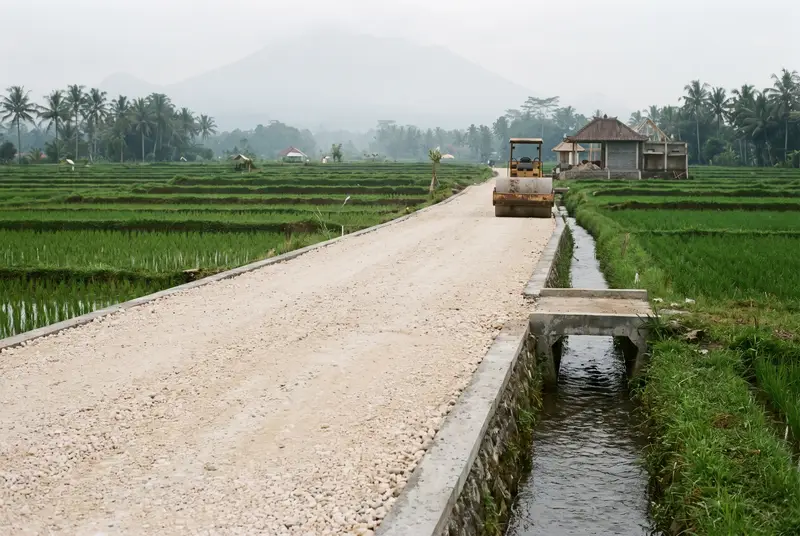
Inside the scope
Site road scope: geotextile, sirtu in lifts, culverts, proof-roll
Route & bearing check
We walk the route, probe the soft spots and design for the heaviest vehicle that must survive it — usually a loaded concrete truck at 25 tons, not your scooter.
Geotextile separation
Fabric between mud and stone is what keeps a paddy road alive: the sirtu stays up, the clay stays down, and February doesn’t swallow your budget.
Sirtu base in lifts
Limestone sirtu placed in 15–20 cm layers, each compacted before the next. One thick tipped layer looks the same on day one and utterly different after rain.
Compaction to refusal
Vibro roller passes until movement stops, checked by proof-rolling with a loaded truck. If it ruts under our truck, it was never going to hold yours.
Culverts & subak crossings
Water keeps flowing — through proper culverts, never blocked channels. Subak crossings are agreed with the village before a single stone crosses the water.
Surface to spec
Compacted gravel for site roads, or concrete hardstanding where turning trucks, cranes and daily deliveries need a hard, level apron. Same base, different top layer.
The road decides the build
Before your villa exists it is 400 truck movements: soil out, fill in, stone, steel, and the non-negotiable ones — concrete trucks that must arrive on pour day, loaded, on schedule, whatever the weather did last night. Plots in Seseh and Kedungu sell at frontier prices precisely because that last hundred meters doesn’t exist yet. Building it properly is not overhead — it’s the purchase that makes every later rupiah spendable.
Why roads over paddies sink (and how ours don’t)
Rice paddy is engineered to hold water — which makes it the worst road base on Earth. Tip stone straight onto paddy mud and the mud simply swallows it: each wet week the stone rides lower, and by month three you’ve bought the same road twice. The fix is separation: geotextile fabric spread over the mud so stone and clay can press against each other without mixing. Thirty centimeters of compacted sirtu on fabric carries a loaded mixer over ground you can’t walk on in sandals. Physics, five dollars a square meter, priceless in February.
Subak is sacred — cross it accordingly
Most frontier plots sit behind living irrigation. The subak system is a thousand years old, legally protected, and run by people who will absolutely stop your project if you disrespect the water. We’ve built dozens of crossings and the method never varies: meet the pekaseh first, agree the point and the culvert size, keep water flowing every single day of the work, leave the channel edge better than we found it. Owners sometimes ask if we can skip the meetings and just be fast. No — and any crew that says yes is selling you a future problem with your entire village.
After the build: the site road becomes the base
Build the temporary road heavy enough to serve as a foundation later. During the build it carries machines and mixers; after handover the same compacted base can take a permanent surface — gravel, paving stone or concrete — which is a separate job covered on our driveway construction page. Lay utility trenching along the same corridor before any surface goes on, and the corridor is dug once and finished once.
What access costs in 2026
Temporary site roads from IDR 240,000/m² (a 100 m × 3.5 m road ≈ 84 million over firm ground); paddy causeways add the soft-ground premium; a permanent compacted gravel road from 320,000/m² and concrete hardstanding from 480,000. A culvert crossing runs from 4.5 million with village agreement included in the process. Send the route — pin to pin — and we’ll price it from the desk today, then walk it before fixing the number. Full rate card on the pricing page.
Pricing
Access road prices per m² (2026)
| Work | Unit | Price (IDR) |
|---|---|---|
| Temporary site road (geotextile + sirtu) | per m² | from 240,000 |
| Permanent gravel road, compacted | per m² | from 320,000 |
| Concrete hardstanding / apron | per m² | from 480,000 |
| Culvert crossing, installed | per unit | from 4,500,000 |
| Paddy causeway premium (soft ground) | per m² | +80,000 |
| Maintenance pass (regrade & top-up) | per visit | from 1,800,000 |
July 2026 rates. Length, width and ground softness set the total — a drone shot or pin-to-pin route on the map is enough to start. Full price list on the pricing page.
Read the table as honest orientation rather than a public offer; the binding figure is set in the written quote that follows the free plot walk.
Price your road today: send the route pin-to-pin, the road width you need and a short video of the ground — we reply with a per-m² estimate the same day and walk the route before fixing the number.
Price My Access RoadFAQ
Access roads in Bali — FAQ
Will a loaded concrete truck really make it to my pour?
That’s the design question we start from: 25 tons on the worst wet-week of your build. Geotextile plus 30–40 cm of compacted sirtu carries it over former paddy; soft spots get dug out and rebuilt, not buried. We proof-roll with a loaded truck before handover — if it ruts, we fix it before you ever see it.
Can a temporary site road stay as a permanent access road?
Yes — and planning for it saves real money. Built on geotextile with 30–40 cm of compacted sirtu, the site road outlives the build: after handover we regrade it, top it up with fresh sirtu and cast concrete hardstanding where vehicles turn. One base, one mobilization less than building a second road later.
Our plot is behind rice fields. How does the road cross the subak?
Carefully and with permission. Subak channels are living irrigation with legal and ceremonial weight — we meet the pekaseh (water chief) with the banjar, agree the crossing point, install a culvert that preserves full flow, and often improve the channel edge while we’re there. Done this way, crossings get approved; done any other way, projects get stopped.
What does the rainy season do to a gravel road?
A properly built one — geotextile, crowned profile, side drainage — sheds water and survives with an annual top-up. A tipped-stone road without fabric pumps mud up through the stone and dissolves by February. See our rainy season guide for what we build in which months.
How fast can you build 100 meters of access road?
Over firm ground: 2–3 working days including compaction. Over soft paddy with a culvert crossing: 4–6 days. The schedule matters most before a concrete pour — tell us your pour date and we work backwards from it, with a buffer for the radar.
Get a free site visit and a volume-based quote
Send us your location pin and a few photos of the land on WhatsApp. We visit the site, measure levels, calculate real volumes and send a line-by-line volume quote — normally back with you inside 24 hours, and you owe nothing for it.
FREE SITE VISIT · QUOTE IN 24H · OWN MACHINES