Septic tank installation in Bali — excavation, tanks and soakaways
We size, dig and install septic systems for Bali homes and villas: a 3–7 m³ concrete two-chamber tank or a sealed bio unit, the soakaway field, vents, inspection covers and a water test before backfill. Standard systems from IDR 15 million installed, 3–5 working days, our own crew and machines since 2019. Send the plot pin, bedroom count and a few photos on WhatsApp — size and price back within 24 hours.
FREE SITE VISIT · QUOTE IN 24H · from IDR 15,000,000
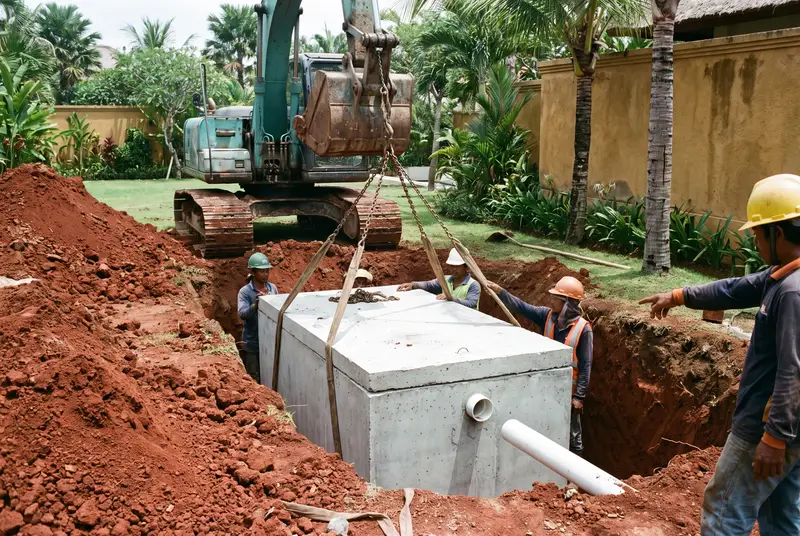
Inside the scope
What a septic install includes: pit, tank, soakaway, test
Sizing from real occupancy
A 2-bedroom home and a 6-guest rental villa are different systems. We size from bedrooms, guests and laundry habits — not from whatever ring is on the truck.
Excavation & base
Pit dug to stable ground with working room, dewatered where the water table argues, base levelled — the tank sits flat forever or it cracks early.
Tank build / install
Two-chamber concrete tanks built and rendered watertight on site, or factory bio-septic units craned in — both plumbed with proper T-baffles and vents.
Soakaway field
The half everyone skips: perforated distribution into a gravel field or structured pit, sized for your soil’s real absorption. This is what makes the system last.
Vents & access covers
Vent stacks placed away from terraces (smell physics is simple and merciless), inspection risers to grade so pump-outs don’t require archaeology.
Commissioning & documents
Water-tested before backfill, locations drawn on a one-page as-built for your villa file — future owners and pump trucks will thank you.
No sewer, no shortcuts
Outside a few Denpasar streets, every building on this island treats its own wastewater. That one fact explains most of Bali’s septic folklore: the tank pumped monthly (undersized), the mysterious wet patch (failed soakaway), the bathroom smell at low pressure (venting). A septic system is three parts — tank, soakaway, venting — and it works only when all three are designed. We install the whole triangle, and we’ll decline politely to install just the photogenic third.
Sizing is arithmetic, not vibes
The failure mode we meet weekly: a rental villa in Canggu sleeping eight, running two wash cycles a day, on a tank sized for a family of three — because that’s the ring diameter the builder had. Retention time collapses, solids reach the soakaway, the soakaway clogs, and by August the garden reports it. Sizing from real occupancy costs perhaps three million rupiah more on day one; re-drilling a dead soakaway field costs eight, plus the smell’s cameo in your guest reviews.
High water table? Different playbook
In Sanur and the coastal strips, wet-season groundwater can sit a meter down — right where a conventional soakaway wants to breathe. Pouring effluent into saturated ground doesn’t treat it; it relocates it. There the honest system is a sealed bio unit with a shallow, wide distribution field, or engineered mound designs where space allows. They cost more. They also mean your well water stays the kind you’d drink — worth saying plainly because not every installer will.
Replacements and rescues
Half our septic work is surgery on someone else’s: collapsed lids from the era of thin concrete, tanks that turned out to be a single unbaffled pit, soakaways installed in pure clay. Diagnosis first — camera, dye test, an hour of honest looking — then the smallest fix that truly fixes. Sometimes that’s a new soakaway beside a healthy tank for 5.5 million, not an 18-million replacement. The quote tells you which, and why, in plain language.
Concrete two-chamber or bio unit — which tank type
Two designs cover nearly every plot. The two-chamber concrete tank is built in the pit — chambers rendered watertight, T-baffles in and out, a vent, a soakaway taking the settled water. It is affordable, repairable and right for most gardens where the soil drains. The sealed bio unit is a factory fibreglass tank with treatment media inside, craned in whole; it earns its premium where groundwater runs high, where the plot squeezes the system toward a well, or where a rental wants cleaner effluent on record. When your site genuinely allows both, the quote carries both numbers.
Where the tank is allowed to go: SNI 2398:2017 and the 10 m rule
Placement is fixed by distances before taste gets a vote. Indonesia’s septic design standard, SNI 2398:2017, and long practice agree: hold every soakaway a full 10 m from any drinking-water well on either side of the fence, put the tank below the well where the land slopes, and stay clear of footings and the boundary so the pit undermines neither. One rule no standard writes down: the pump truck must park within hose reach, or the tank can never be emptied. For a house there is normally no separate septic licence — the system sits in the sanitation drawings of the building approval (PBG). On a narrow Canggu plot these lines decide the whole layout, so we draw them before any machine arrives.
The pit in Bali’s three grounds
A typical residential pit runs 2.5–3 m deep with working room around the tank. Paddy clay in Canggu, Pererenan and Seseh digs fast, but open walls slump, so the base is trimmed and blinded the same day. On the Bukit — Uluwatu, Ungasan, Pecatu — the pit is breaker work through limestone: slower per metre, though the rock gives you a soakaway that drains well. Ubud’s volcanic loam digs and drains well; the access track is the real constraint. Along coastal Sanur the water table can run high enough that pumps work in the hole while the base goes in. Soil by area is mapped in our Bali soil types guide.
Installation in five steps
- Set-out and a test dig. Well and boundary distances are marked, and one bucket goes down to confirm soil and water level before the price is fixed.
- Pit and connection trench. Machine dig where access allows, hand dig in tight lanes; the lateral from the building’s outlet pipe is trenched at a steady fall.
- Base and tank. A levelled concrete working base, then the chambers go up and get a watertight render — or the bio unit is set and ballasted so it cannot float.
- Soakaway and vent. A gravel field or structured pit sized to the soil’s tested absorption, with the vent riser run where no terrace will ever smell it.
- Test, backfill, record. The tank must hold water before it disappears, and every position lands on a one-page drawing that stays with the house papers.
After handover: desludging every 2–4 years
A correctly sized system asks for little: a desludge every two to four years — sooner for a rental at constant full occupancy — and inspection covers kept reachable at grade. Watch for the soakaway warnings: a stripe of suspiciously lush lawn, a wet patch that outlives the rain. And keep roof and yard water out of the septic — it belongs in its own drainage, because every storm surge through a tank pushes solids into the soakaway and shortens its life. In the wet season an empty tank in saturated ground behaves like a boat, so wet-season installs are ballasted and backfilled the same day — see the rainy season guide.
Money and the right moment
Standard systems from IDR 15 million installed; full villa systems from 22; bio units from 18. The cheap moment is during your build — machines already on site through the foundation stage, no landscaping to protect, trenching to the bathrooms open anyway (see utility trenching). The expensive moment is after the garden wins awards. Full rates on the pricing page; the site visit and sizing calculation are free.
Pricing
Septic tank prices in Bali by tank size (2026)
| Tank size | Typical use | Concrete 2-chamber + soakaway | Bio septic unit, installed |
|---|---|---|---|
| 3 m³ | 1–2 bedrooms | from 15,000,000 | from 18,000,000 |
| 5 m³ | 3 bedrooms | from 18,000,000 | from 23,000,000 |
| 7 m³ | 4–6 bedroom villa | from 22,000,000 | from 30,000,000 |
Repairs, soakaways and connections
| Work | Unit | Price (IDR) |
|---|---|---|
| Replace collapsed / failed old tank | package | from 17,500,000 |
| Soakaway field only (existing tank) | per unit | from 5,500,000 |
| Access riser & new covers retrofit | per unit | from 900,000 |
| Machine trench for the connection run, 60 cm deep | per m | from 120,000 |
| Hand trench near walls and in tight sites | per m | from 200,000 |
Orientation prices for 2026, excavation included; tank size follows our rule of 1.5–2 m³ per bedroom, more for full-occupancy rentals. Water table, rock and truck access set the final figure — the exact quote comes after the free site visit. Full price list on the pricing page.
Read the table as honest orientation rather than a public offer; the binding figure is set in the written quote that follows the free plot walk.
Not sure which size you need? Send the plot pin, bedroom count and whether it is a family home or a rental — we reply with the tank size, the soakaway layout and a written price within 24 hours.
Size My Septic on WhatsAppFAQ
Septic systems in Bali — FAQ
What size septic tank does a 3-bedroom villa need in Bali?
Our sizing rule: roughly 1.5–2 m³ of tank volume per bedroom for owner-occupied homes, more for rentals running full occupancy and daily laundry. A typical 3-bedroom villa gets a 5–6 m³ two-chamber tank plus a properly sized soakaway. Undersized tanks don’t fail politely — they fail into your garden in high season.
Concrete tank or bio septic — which should I choose?
Concrete two-chamber: cheaper, repairable, proven — right for most sites with soil that drains. Bio septic (sealed factory unit): wins where groundwater is high (Sanur, coastal Canggu), where the plot is tight against wells, or where a rental’s eco-credentials matter. We quote both when your site genuinely allows both.
How far must a septic tank be from a well?
Keep 10 m or more between any soakaway and a drinking-water well — yours or the neighbour’s — and put the tank downhill of wells where the slope allows. On small plots this geometry decides the whole layout, which is why we draw it before digging anything.
Why does our existing septic smell?
Three usual causes: missing or broken T-baffles letting scum reach the outlet, a dead vent (painted over, capped, or never installed), or a saturated soakaway pushing gas back. All three are fixable without full replacement — we diagnose first and quote the repair honestly before anyone sells you a new system.
How long does installation take, and how disruptive is it?
Standard system: 3–5 working days from first dig to water test; bio units are often faster. The mess is one corner of the garden and one truck route, protected with plywood trackway. Do it before landscaping if you possibly can — the same job after the lawn and irrigation go in costs the lawn and irrigation.
How deep does a septic tank need to be buried in Bali?
Most residential pits run 2.5–3 m deep — tank height plus a levelled base and modest cover. The controlling number is the fall of the outlet pipe from the building: the connection must run downhill the whole way, so a long run means a deeper tank.
Do I need a permit for a septic tank in Bali?
For a house there is normally no separate septic licence — the system appears in the sanitation drawings of the building approval (PBG), designed to the SNI 2398:2017 standard. What gets checked on the ground is geometry: well distances respected and the whole system, soakaway included, on your own land.
How often should a septic tank be emptied in Bali?
Every two to four years for a correctly sized family system; rentals at constant full occupancy usually need the truck more often. If pump-outs are needed every few months, the tank is undersized or the soakaway has clogged — a design problem, not a schedule problem.
Can a septic tank be installed during the rainy season?
Yes, with discipline: the pit is pumped, and the tank is ballasted and backfilled the same day so it cannot float in saturated ground. The upside is that the soakaway gets designed against the true, highest groundwater level instead of a dry-season reading.
Get a free site visit and a volume-based quote
Send us your location pin and a few photos of the land on WhatsApp. We visit the site, measure levels, calculate real volumes and send a line-by-line volume quote — normally back with you inside 24 hours, and you owe nothing for it.
FREE SITE VISIT · QUOTE IN 24H · OWN MACHINES