Site Grading & Cut and Fill in Bali — Land Leveling to Design Levels
We level Bali plots to design levels: laser survey, a cut-and-fill balance plan on paper, fill placed in 20–30 cm lifts and compacted one by one, final grade checked with a laser and the grade stakes left in. Cut and fill moved on site from IDR 95,000/m³; on one Kedungu plot we balanced 1,100 m³ with no trucks in or out. Send the plot pin and any survey or drawing on WhatsApp — volume calculation free, quote in 24 hours.
FREE SITE VISIT · QUOTE IN 24H · from IDR 95,000/m³
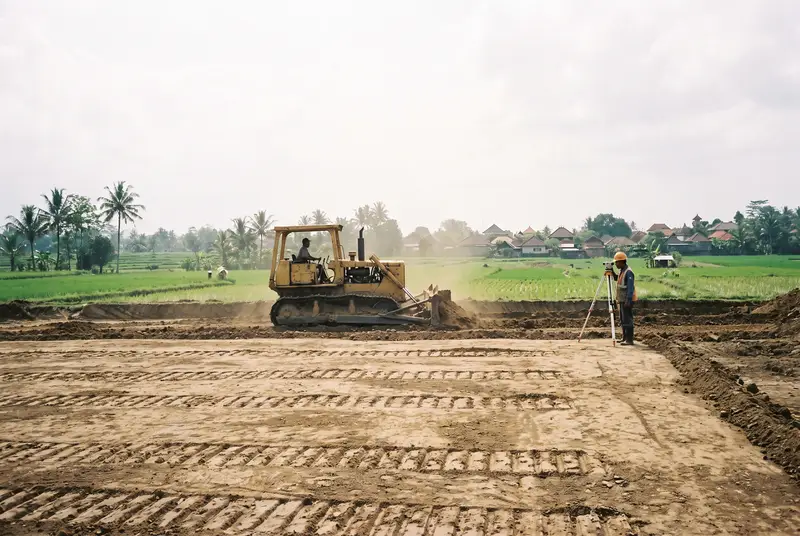
Inside the scope
Grading scope: survey, balance plan, compacted lifts, laser check
Topo measure & volumes
We shoot your plot’s levels with a rotating laser (or fly it for big sites), then calculate cut and fill volumes before quoting. Numbers first, machines second.
Balanced grading plan
Where possible, soil cut from the high side fills the low side. A balanced plan is the single biggest cost saver in Bali earthworks — fewer trucks, faster job.
Cut to design levels
Building pads, pool terraces and driveway alignments cut to the architect’s levels — checked continuously, not “we’ll fix it at the end”.
Fill in compacted lifts
Fill placed in 20–30 cm layers, each compacted before the next. This is what makes fill buildable instead of a future crack in your slab.
Laser final grade
Pads finished to ±30 mm, falls graded away from buildings, crowns on driveways. The site drains the day we leave.
Stakes for verification
Grade stakes and benchmarks stay in place at handover, so your architect or builder can verify every level against the drawing — most do, and that’s the point.
The cheapest truck is the one that never comes
Here’s the arithmetic nobody shows you: hauling one truck of soil off a plot and buying one truck of fill back costs around IDR 1.85 million together. A sloped 15-are plot graded without a balance plan can burn 60+ truck movements — IDR 50–100 million of pure logistics. The same plot with cut and fill balanced on site: sometimes zero trucks. That calculation, done before quoting, is the whole philosophy of this company. We’d rather win your job with a smaller number than pad it with trucks you didn’t need.
What a grading plan actually shows
After the laser survey you get a simple drawing: existing levels, design levels, where we cut, where we fill, and the balance number — surplus or deficit in m³. On Kedungu’s big coastal plots this is the document that decides whether your budget is 90 million or 250. It’s also your protection: when volumes are on paper, “oh, actually we need 30 more trucks” can’t happen mid-project.
Compaction is a religion here
Fill without compaction isn’t land, it’s stored settlement. Every lift of fill we place — 20 to 30 cm — gets rolled or plate-compacted before the next goes down, with moisture managed (dust-dry soil compacts as badly as soup). We photograph the layers as we go, and if your engineer wants field density tests, we schedule around them happily. A year later, when your tiled floor is still flat, this is the paragraph that did it.
Paddy, slope and everything between
Former rice fields in Seseh need their saturated mud stripped before any fill goes down — building on paddy mud is Bali’s most repeated (and most expensive) shortcut. Slopes above Ubud and in Pererenan become stepped terraces, usually with retaining walls priced in the same document, because grading and walls on a slope are one system. Flat urban plots in Denpasar? Half a day of laser grading turns puddle-land into a drained pad.
Cut and fill price per m³ in Bali (2026)
Soil moved and compacted on site from IDR 95,000/m³; imported fill from IDR 1,100,000 per truck delivered. Worked example: 1,100 m³ balanced on a Kedungu plot — no trucks either way — comes to roughly IDR 105 million at our October 2026 rates, including compaction and final laser grade, six working days. The same job hauled and re-imported would cross 210. Volumes for your plot get calculated free with the site visit; full rates on the pricing page and worked budgets in the cost guide.
Pricing
Site grading rates per m³, m² and truck
| Work | Unit | Price (IDR) |
|---|---|---|
| Cut and fill, moved on site | per m³ | from 95,000 |
| Imported fill soil, delivered | 7 m³ truck | from 1,100,000 |
| Compaction in 20–30 cm layers | m² / layer | from 40,000 |
| Final grading of building pad | per m² | from 30,000 |
| Topographic survey (standalone) | per plot | 2,500,000 (free with contract) |
| Mobilization, south Bali | per job | 1,500,000–2,500,000 |
October 2026 rates. The grading plan decides the real total — balancing cut against fill routinely removes 30–60 trucks from a budget. Full price list on the pricing page.
Read the table as honest orientation rather than a public offer; the binding figure is set in the written quote that follows the free plot walk.
Get your volumes calculated: send the plot pin, the plot size in are and the architect’s levels if you have them — we calculate cut, fill and the truck balance for free and send an itemised quote within 24 hours.
Calculate My Cut & FillRelated
Crews often pair these
FAQ
Site grading & cut and fill in Bali — FAQ
What exactly is cut and fill?
Cutting soil from the high part of your plot and using it to fill the low part, so the land reaches design levels with minimal trucking. Done right it’s engineering; done wrong it’s a pile of loose soil that settles under your floor. Full explanation with numbers: cut and fill guide →
How accurate is the finished grade?
Building pads hand over at ±30 mm to design level, checked with a rotating laser in front of you. Driveways and landscape areas are graded to falls (typically 1–2%) so water moves where the drawing says it should — verification stakes stay in the ground.
Can you build on fill immediately?
On properly compacted engineered fill — yes, for slabs and light structures, and your engineer can test it (we welcome field density tests). On loose-tipped fill — never; it settles for years. This is why our fill goes down in compacted lifts, and why we photograph each layer.
My plot is below road level. Where does fill come from?
Can rice paddy be turned into a building pad?
Yes — it’s half our work in Seseh and Kedungu. The paddy mud (soft, organic, saturated) is stripped first; building on it is how floors crack. Then geotextile where needed, engineered fill in lifts, compaction, and a pad your engineer will sign off. Budget honestly: paddy conversion costs more than it looks.
Get a free site visit and a volume-based quote
Send us your location pin and a few photos of the land on WhatsApp. We visit the site, measure levels, calculate real volumes and send a line-by-line volume quote — normally back with you inside 24 hours, and you owe nothing for it.
FREE SITE VISIT · QUOTE IN 24H · OWN MACHINES