Building on a Slope in Bali: Earthworks, Walls and Real Costs
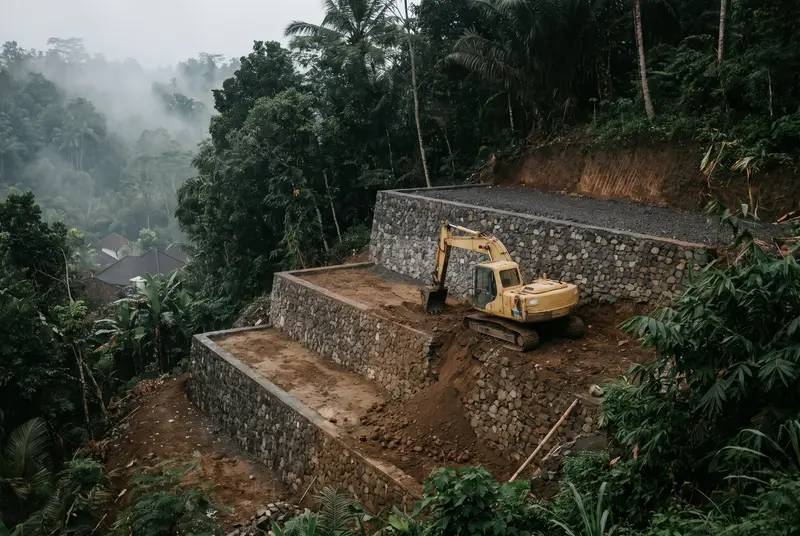
Sloped land in Bali sells at a discount and builds at a premium. The view plots above the Pererenan gorge, the jungle shelves around Ubud, the hillside cuts over Jimbaran bay — they are cheaper per are for exactly one reason: somebody has to make them flat, hold them flat, and keep water from taking them back. That somebody is us, and here is what it honestly costs in 2026.
What the discount on sloped land actually buys you
Across the sloped jobs we ran this year, site preparation landed between IDR 180 and 280 million more than the same house on flat ground would have needed — occasionally double that on the Bukit, where the cut is limestone rather than soil. That money goes into four buckets, in this order of size: retaining structures, earth moving, access, and drainage. None of them are optional, and three of them are invisible in the finished photos.
The good news is that sloped plots reward planning more than flat ones. Balanced cut and fill on a hillside removes trucks in both directions at once, and a terrace layout adjusted by half a metre on paper can delete a whole run of wall. Read how cut and fill balancing works before your architect freezes the levels — after that, everything is more expensive to change.
Two strategies: terracing or standing on stilts
Terracing cuts the hill into flat steps and holds each step with a wall. It gives you real gardens, level pool decks and simple construction on top, and it is what most Bali villas do. The cost is earthworks-heavy: cut, fill, compaction, and walls that get expensive fast with height.
Stilts and columns leave the slope roughly where it is and carry the building on deep footings or bored piles. Earthworks shrink to footing excavation and an access track, but the structural budget grows and you get no usable outdoor terrain underneath. On very steep ground — the drops behind Bingin, some Ubud river plots — it is often the only sane answer.
In practice most projects are hybrids: one or two cut terraces for the house and pool, columns for the parts that reach out over the drop. What decides the split is soil depth and gradient, which is why we like to test-pit before the design is final rather than after.
Retaining walls: the number that dominates your budget
Wall cost does not grow with height — it grows with height squared, because a taller wall needs a wider base to stay put. Doubling retained height from 1.5 m to 3 m multiplies the price per running meter by roughly 3.4. This single fact should shape your terrace layout: three 1.2 m steps are dramatically cheaper than one 3.6 m wall, even though they hold the same hill.
| Retained height | Batu kali gravity | Gabion | Reinforced concrete |
|---|---|---|---|
| 1.0 m | ~760,000/m | ~1,350,000/m | not economical |
| 1.5 m | ~1,520,000/m | ~2,030,000/m | ~2,190,000/m |
| 2.0 m | ~2,480,000/m | ~3,380,000/m | ~2,990,000/m |
| 2.5 m | ~3,620,000/m | ~4,730,000/m | ~4,070,000/m |
| 3.0 m | ~5,140,000/m | ~6,080,000/m | ~5,310,000/m |
| 4.0 m | engineer’s design | rarely suitable | ~8,440,000/m |
These are built-wall prices per running meter, derived from our unit rates: batu kali from IDR 1,900,000/m³, gabion from 1,350,000/m³, reinforced concrete from 2,950,000/m³. Add 15–25% for excavation behind the wall, gravel backfill, weep holes and the drain that keeps it standing. Full rates sit on the pricing page, and the build detail on retaining wall construction.
Choosing between them, briefly: batu kali is cheapest to about 3 m, repairable, and looks like Bali. Gabion costs more per running meter but drains through itself and tolerates slight ground movement — our default on river gorge edges in Pererenan and on wet jungle slopes near Ubud. Reinforced concrete wins where the section must be thin against a boundary, where the wall is tall, or where a pool or driveway sits directly above it.
Drainage is what keeps the wall standing
Nearly every failed retaining wall we are called to inspect failed for the same reason: water got behind it and had nowhere to go. Saturated backfill roughly doubles the pressure on a wall, and Bali delivers that test every wet season, usually in one January night.
- Weep holes every 1.5–2 m, lowest row just above finished ground.
- Gravel backfill zone 30–40 cm wide behind the full wall face, wrapped in geotextile so clay does not clog it.
- A perforated drain at the base — a French drain from IDR 450,000/m, falling to a real outlet, not into the neighbour’s land.
- A cut-off channel above the terrace, so hillside runoff never reaches the backfill at all. Cheapest protection you can buy.
Budget roughly 10–18% of the wall cost on drainage. It is the line owners try to delete when the quote comes in high, and the only line that ever gets rebuilt at four times the price. Timing matters too — see earthworks in the rainy season before scheduling a slope job between November and March.
Access: can a machine get there at all?
On flat land access is a detail. On a slope it is a line item. Before quoting we establish three things: whether a 20-ton machine can safely walk down and back up, whether soil can be loaded directly into trucks or must be shuttled uphill by mini excavator, and whether a temporary site road is needed first — from IDR 240,000/m², which on a 90-metre Ubud driveway is already 65 million before a bucket touches the house pad. On the cliff plots near Bingin and parts of Uluwatu we have run entire digs with a mini machine and conveyor because nothing larger could physically get in.
Three real slope budgets
1. River gorge plot, Pererenan — 6 are, one main terrace.
- Cut and fill, 320 m³ @ 95,000 = IDR 30.4 M
- Batu kali wall, 42 m at 2.2 m average (65 m³) @ 1,900,000 = IDR 123.5 M
- French drain behind the wall, 42 m @ 450,000 = IDR 18.9 M
- Surplus soil out, 8 trucks @ 750,000 = IDR 6.0 M
- Mobilization = IDR 2.0 M
Total IDR 181 million, 16 working days.
2. Jungle shelf above a river, Ubud — 4 are, three terraces.
- Temporary access road, 270 m² @ 240,000 = IDR 64.8 M
- Heavy jungle clearing, 4 are @ 4,500,000 = IDR 18.0 M
- Three large trees felled and removed @ 1,500,000 = IDR 4.5 M
- Terracing cut and fill, 480 m³ @ 95,000 = IDR 45.6 M
- Gabion walls, 66 m total (59 m³) @ 1,350,000 = IDR 79.7 M
- Drainage, 60 m @ 450,000 = IDR 27.0 M
- Mobilization = IDR 2.5 M
Total IDR 242 million, five weeks. Note that the driveway alone was 27% of it — on Ubud plots, access frequently outcosts the terracing.
3. Hillside cut above the bay, Jimbaran — soil over limestone.
- Soil cut, 210 m³ @ 95,000 = IDR 20.0 M
- Limestone breaking, 140 m³ @ 490,000 = IDR 68.6 M
- RC retaining wall, 18 m at 3 m (32.4 m³) @ 2,950,000 = IDR 95.6 M
- Spoil out, 63 trucks mixed soil and rock = IDR 55.3 M
- Mobilization, 20-ton machine plus breaker = IDR 2.5 M
Total IDR 242 million, seven weeks. The neighbours were four metres away on both sides, which is why the wall is concrete and thin rather than stone and fat.
Four mistakes we get called to fix
- A wall with no drainage. Solid stone face, no weep holes, clay packed straight behind it. It survives one dry season and bulges in the second. Rebuilding costs more than the original wall, because now the terrace above has to be dug out again.
- Foundations on uncompacted fill. Cut soil pushed downhill, levelled, built on within weeks. Columns settle differentially, ring beams crack diagonally. Footings must reach undisturbed ground, always — see compaction in layers.
- Cutting the toe of a slope with nothing holding it. A vertical cut for a pool or car park at the bottom of a hill removes the support for everything above it. On clay slopes it can move within days, and it is the one situation where we stop work and insist on an engineer.
- Dumping cut over the downhill edge. It is free today and it is your neighbour’s garden, or a river, in February. We haul it out or place it where it can be compacted — and legal disposal is quoted per truck, visibly.
What to check before you buy sloped land
- Gradient and drop. Total fall across the plot in metres — it drives everything downstream.
- Soil depth to rock. Half a metre of soil over limestone in Uluwatu, Ungasan or Pecatu means the cheap dig you imagined is breaker work at 380,000–550,000/m³.
- Access width and gradient from the nearest usable road, and who owns that road.
- Where water arrives from. Stand on the plot in the rain if you can. Anything uphill of you eventually crosses your land.
- Boundary distances — walls near a boundary need a design, not a rule of thumb.
- A rough earthworks budget before you commit. Flat plots in Canggu and Sanur cost 21–32 million to excavate; a sloped plot starts around 180 million prepared. That gap belongs in your land negotiation.
We do slope assessments free, including for land you have not bought yet — several clients have walked away from a plot after our numbers, and consider that the cheapest advice they ever got. Compare the flat-ground baseline in the 2026 excavation cost guide and the dig itself on our excavation page.