How Much Does Land Clearing Cost in Bali? 2026 Rates & Examples
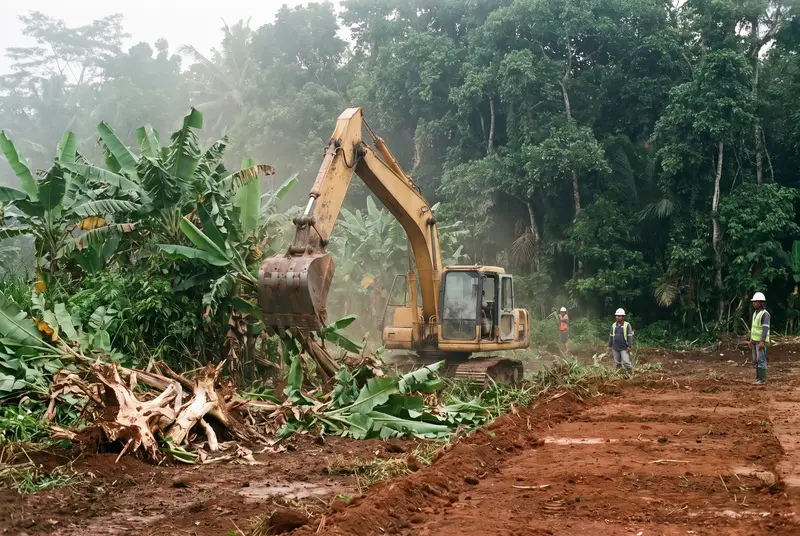
Buy an overgrown plot in Canggu, Pererenan or the hills above Ubud and the first bill is never the foundation — it is getting the green wall down so anyone can even survey the land. Land clearing cost in Bali runs from IDR 1,200,000 per are for light scrub to past IDR 4.5 million per are for honest jungle, and the spread confuses owners because two quotes for “clearing” rarely describe the same work. Here are our real 2026 rates, what pushes a plot from one band into the next, and two itemised budgets from plots we cleared this season.
The short answer: 2026 land clearing rates in Bali
| Work | Unit | Price (IDR) |
|---|---|---|
| Light vegetation & grass | are (100 m²) | from 1,200,000 |
| Medium scrub, bamboo & banana | are | 1,900,000–3,100,000 |
| Heavy jungle incl. removal | are | from 4,500,000 |
| Large tree felling & removal | per tree | from 1,500,000 |
| Root & stump grubbing | are | from 650,000 |
| Topsoil strip & stockpile | m² | from 45,000 |
| Green waste haul-away | 7 m³ truck | from 950,000 |
These are the same numbers published on our land clearing service page, and they are what we quote this week. Site clearing price in Bali is almost always given per are — one are is 100 m², so a 10-are plot is 1,000 m² — and every rate above includes machine, operator, fuel and our supervision. The full rate list, alongside digging and grading, lives on the pricing page.
What decides which band your plot falls into
- Vegetation density. Grass and weeds fall to one machine pass. Bamboo stands, rattan vine and a closed jungle canopy are a different sport — slower cutting, far more debris, and rhizomes that must come out by the root.
- Tree count and size. The per-are rate carries everything up to roughly a 20 cm trunk. Every trunk above that is its own line, priced by diameter and by what it could fall on.
- Terrain. A flat former rice field in Pererenan or Kedungu clears fastest. Terraced slopes in the Ubud valleys and the Tabanan ridges make the machine work in steps, and some edges go to a hand crew so the bunds don’t collapse.
- What’s under the green. On the Bukit — Uluwatu, Bingin, Pecatu — dry savanna scrub cuts quickly, but stumps grip coral limestone and grubbing runs slower. That is the opposite trade from the soft, overgrown flats around Tabanan, where cutting is the slow part and roots pull clean.
- Access. If a truck parks beside the plot, debris is loaded once. Behind a narrow gang in Canggu it gets shuttled out by mini excavator first, and the same vegetation costs 30–50% more to remove.
- Haul distance. The distance to the nearest legal green-waste site sets the truck line. Around Canggu it is short; on the far side of Tabanan the same load spends an hour on the road.
Most plots land in the middle. Dense scrub with bamboo clumps and a few fruit trees — the classic abandoned-garden look from Pererenan to Kedungu — prices at IDR 1,900,000–3,100,000 per are. A paddy gone to grass sits at the bottom of the range; genuine secondary jungle above Ubud sits at the top.
Tree felling cost by trunk diameter
The per-are rate buys vegetation, not standing timber. Trees are counted on the walk-over and priced individually, mostly by diameter at chest height:
| Trunk diameter | How it comes down | Price per tree (IDR) |
|---|---|---|
| Under 20 cm | Dropped and chipped with the scrub | included |
| 20–40 cm | Felled, sectioned, hauled | 750,000–1,100,000 |
| 40–60 cm | Taken down in pieces, top first | 1,100,000–1,500,000 |
| Over 60 cm, or near structures | Rigged and sectioned, crane if needed | from 1,500,000 |
Coconut palms are simpler than they look — a climber takes the crown, the trunk drops clean, and 750,000–900,000 per palm including haul-away is normal. Hardwood is the opposite of waste: teak or mahogany logs get stacked at the boundary and they are yours, which on some Tabanan plots quietly offsets a chunk of the clearing bill. Need one or two trees and their stumps out without clearing the whole plot? See tree removal in Bali — same crew, priced per tree.
Debris: where the money hides
Cleared vegetation is absurdly bulky — a plot that took years to overgrow leaves in a convoy. After chipping, plan on roughly one 7 m³ truck per are of light growth and 1.5–2 loads per are of heavy jungle, at 950,000 per load to a legal green-waste site. On a 10-are jungle plot that is 12–20 trucks, often a quarter of the entire bill. We chip on site precisely to cut that convoy by a third, we stack usable timber for the owner, and we do not burn — ever. Burning is illegal smoke over your neighbours’ pools and the fastest way for a project to lose its street.
Two clearing quotes that differ by millions usually differ in one line: how many trucks of debris leave the plot, and where they go. Count trucks first, ares second.
How long it takes: 5, 10 and 20 are
| Plot size | Light growth | Heavy jungle (incl. grubbing) |
|---|---|---|
| 5 are | 1 day | 2–3 days |
| 10 are | 1–2 days | 3–5 days |
| 20 are | 2–3 days | 6–10 days |
Add a day if topsoil is stripped and stockpiled first — worth doing, because the top 20–30 cm of a jungle plot is years of fertility your landscaper would otherwise buy back by the truck. Wet-season mud adds roughly 20–30% to machine time on clay ground; the calendar effect is real but smaller than most owners fear.
Excavator or hand crew?
A PC50–75 mini excavator — it fits through a 1.8 m gate and runs from IDR 3,400,000 per day with operator and fuel — does nine-tenths of Bali clearing: it cuts brush, rips bamboo rhizome and grubs stumps in one mobilization. For 20-are-plus plots and big root plates we bring a PC200-class 20-ton machine (from 5,400,000/day) that pulls a teak stump in minutes instead of an hour. A hand crew still wins in three places: around tagged keep-trees, on narrow Ubud terraces where a machine would flatten the bund, and on tight Canggu gang plots where the flatbed costs more than the labour. Most real jobs are a mix, and the mix is what the quote should show.
Felling permits, the banjar and the trees you keep
Most garden and scrub species on your own land need no permit — you can clear tomorrow. Large banyans, anything shading a temple and trees the village considers significant need a conversation with the banjar first, occasionally with a small ceremony; we have that conversation before the machine arrives, not after. The walk-over is also where keep-trees get ribbon-tagged and the subak channel gets flagged. A mature tree adds real money to a villa plot in Uluwatu or Ubud — felling one should be a decision made standing next to it, never a surprise in the site photos.
Dry season vs rainy season
April to October is the clearing high season: machines track fast on firm ground, debris trucks keep their schedule, and the diary fills — book one to two weeks ahead. November to March still works; clearing is the one earthworks job that runs year-round. Mud slows tracked machines on the clay around Tabanan and in the Ubud valleys — the free-draining limestone shelf around Uluwatu barely notices — haul routes need more care, and we rough-grade before demobilising so the bare plot sheds water instead of ponding. The full wet-season playbook is in earthworks in Bali’s rainy season.
Worked example 1: 5 are of scrub in Pererenan
Abandoned garden plot two streets back from the beach road in Pererenan — chest-high scrub, banana clumps, six old coconut palms. At our October 2026 rates, rounded:
- Plot walk, boundary pins found, keep-trees tagged — included
- Light-to-medium clearing, 5 are @ 1,400,000 = IDR 7.00 M
- Root & stump grubbing, 5 are @ 650,000 = IDR 3.25 M
- Six coconut palms felled and hauled @ 800,000 = IDR 4.80 M
- Green waste out, 4 trucks @ 950,000 = IDR 3.80 M
Total IDR 18.9 million (~USD 1,150), two working days, and the survey crew was on the plot the morning after. For a first villa plot in Canggu or Pererenan, that is the typical shape of the number.
Worked example 2: 10 are of jungle above Ubud
Secondary jungle on a ridge north of Ubud — closed canopy, bamboo, four big trees, machine access down an old farm track. The heavy end of the market looks like this:
- Heavy clearing incl. removal, 10 are @ 4,500,000 = IDR 45.00 M
- Four large trees (60 cm+) rigged and sectioned @ 1,500,000 = IDR 6.00 M
- Root & stump grubbing, 10 are @ 650,000 = IDR 6.50 M
- Topsoil stripped and stockpiled off the build pads, 120 m² @ 45,000 = IDR 5.40 M
- Green waste out after chipping, 14 trucks @ 950,000 = IDR 13.30 M
Total IDR 76.2 million, five working days, plus a timber stack of teak the owner later milled for doors. The same ten are under light growth would have been under IDR 22 million — that gap, not the machine rate, is why a walk-over beats a phone estimate every time.
Cleared is not the same as buildable. Next in the chain is usually site grading and cut and fill to design levels, then the foundation excavation itself — and if you are budgeting the whole sequence, our 2026 excavation cost guide carries the same style of worked numbers from clearing through to the dig.
Checklist before you sign a clearing quote
- Plot size written in are, and the per-are rate with its band named — light, medium or heavy.
- Trees listed by count and diameter, with keep-trees tagged before any machine arrives.
- Root and stump grubbing stated as included or priced — ask where the roots go.
- Truck count and the destination site named. “Debris handled” is not a destination, and burning is not a method.
- Topsoil: stripped and stockpiled for your landscaping, or hauled away with the rest?
- Working days, and what happens to the schedule if rain stops the site.
- Boundary pins found and flagged, subak channels marked, banjar spoken to about any significant trees.